2026 Marketing Playbook for Landscape Contractors: Adapting to the AI Revolution
https://youtu.be/s9Kh0ifbB8I?si=R5jOxhE_Tml6u8tt
The way customers find landscape and hardscape contractors is changing fast. Search is no longer a single channel controlled by one company. Artificial intelligence now powers “answer engines” that scan websites, profiles, reviews, social posts, community forums, and short videos to recommend businesses.
This playbook lays out what to prioritize in 2026: how to structure your online presence so AI recommends your business, what content to produce, which technical signals matter, and the simple steps you can implement today to win more qualified leads.
Table of Contents
- Why AI search matters for contractors
- How AI platforms show contractor results (what they actually reference)
- AEO vs SEO: what’s changed and what still matters
- Technical foundations every contractor must have
- On-page content structure that wins AEO
- The single most underused AEO signal: short-form video
- Off-site authority signals: reviews, directories, and mentions
- Practical playbook: step-by-step checklist (start here)
- How to reverse-engineer competitors and AEO winners
- Measuring success and optimizing spend
- Start small: three prioritized actions for the next 30 days
- Quick implementation tips
- Frequently asked questions
- Final note
Why AI search matters for contractors
People are moving from typing queries into a search bar to asking conversational AI tools for recommendations. These platforms – think ChatGPT, Gemini, Perplexity, and similar systems – return synthesized answers, and cite the sources they drew that information from. That means the platforms you and your customers use to research work as an information pipeline: if your business shows up in the sources they read, you get recommended.
Two big implications:
- Visibility requires being discoverable across multiple platforms – websites, Google Business Profile, review sites, social platforms, MS, and community forums – all of which feed the AI models.
- Clarity beats keywords: – AI looks for clear, structured statements about who you are, what you do, and where you serve. Those signals are more important than stuffing keywords on a page.
How AI platforms show contractor results (what they actually reference)
Different answer engines pull from slightly different sources, but several patterns are consistent. Examples below show the types of signals each platform uses and what contractors should optimize first.
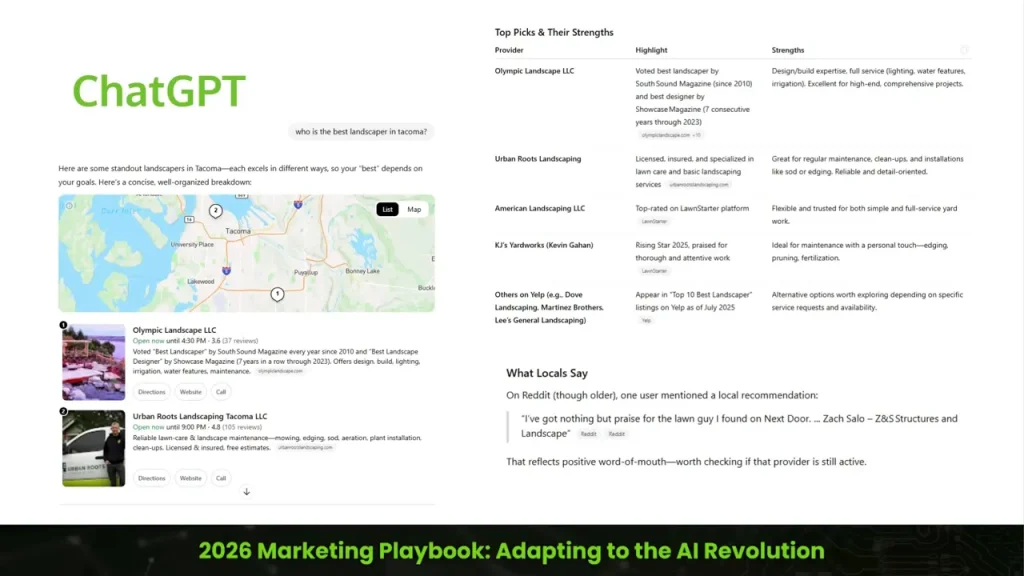
Chat-style AI (ChatGPT / Bing)
These models often pull business data from map listings (Bing Maps, Google Maps), profiles, and local directories. They also highlight a few top picks and list strengths or specializations when available. That makes it critical to have clear statements on your site and profiles about your specialties, years in business, and standout services.
Google Gemini and Google AI Overviews
Gemini can reference Google properties directly, including Google Business Profile fields, reviews, hours, and address. If your GBP is inactive or incomplete, Gemini is less likely to surface your business.
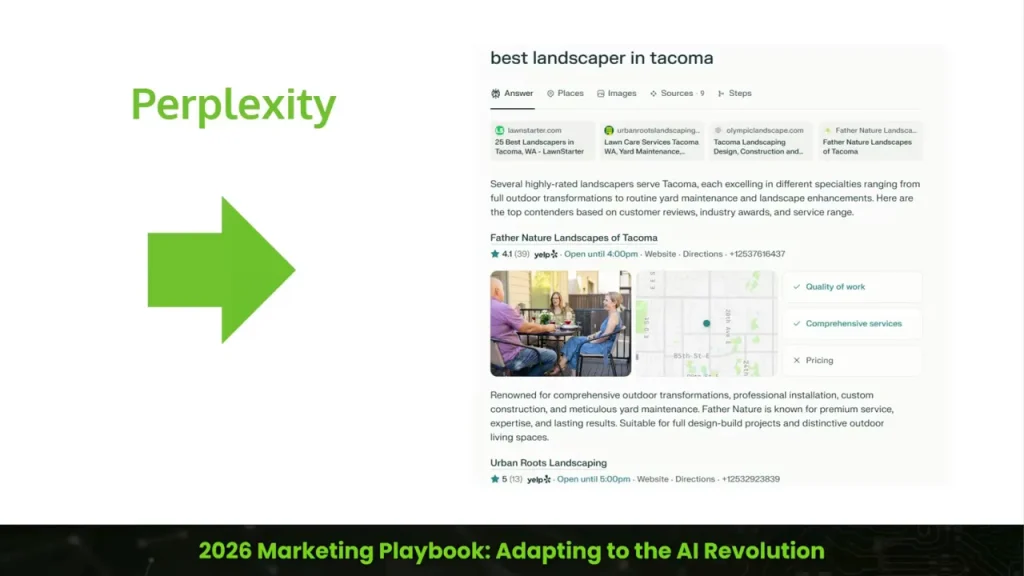
Perplexity and similar research-first engines
These platforms explicitly list their sources. If the same contractors and the same web pages keep appearing across Perplexity results, those pages are the ones feeding AI recommendations. You can actually reverse engineer what AI references by checking the sources it lists.
Other frequent sources: Yelp, Nextdoor, Reddit, and local news. Even if you don’t love a platform, AI might reference it – so claim and complete the profiles you can.
AEO vs SEO: what’s changed and what still matters
Answer Engine Optimization (AEO) is the practical evolution of SEO. The core remains the same: make it easy for machines and humans to understand what you do and where you operate. But AEO requires more distributed signals:
- On-site clarity: – pages that clearly describe services, processes,s and service areas.
- Structured data: – schema markup that tells AI models what each page is about.
- Off-site validation: – reviews, directory listings, and brand mentions that corroborate your claims.
Old-school tactics like keyword stuffing are less effective. Focus on branding statements that answer AI’s questions: who you are, who you serve, what you specialize in, and why customers choose you.
Technical foundations every contractor must have
These foundational items are high-impact and relatively low-effort to implement. Get them right first.
- Consistent NAP: – Name, Address, and Phone must be identical across your website, Google Business Profile, and directory listings. AI treats discrepancies as uncertainty.
- Schema markup: – Add relevant structured data (LocalBusiness, Service, Product, Review) so language models can reliably interpret pages.
- Claim and complete core profiles: – Google Business Profile, Yelp, Facebook, Nextdoor, and any major local directories for your region.
- Active review strategy: – Encourage customers to leave reviews on Google and Facebook. AI reads review text and uses it as evidence of what you do well.
On-page content structure that wins AEO
Treat your site like a knowledge base for both humans and AI. Pages that are structured, specific, and localized perform best.
- Service pages: – Create a page for each core service (e.g., hardscape design, pool decks, retaining walls). Include features, benefits,s and typical project scope.
- Location pages: – Create pages for each city or service area you serve, with local references and examples.
- Project pages: – Build detailed case studies, not just image galleries. Describe the problem, the solution, materials used, timeline, and outcomes.
- Articles and how-tos: – Write localized, specific articles about the things you do best (e.g., “Best paver choices for coastal yards in Tacoma”).
- Testimonials and reviews on-site: – Pull in curated testimonials that contain concrete details about the work and results.
The single most underused AEO signal: short-form video
Short videos are becoming a category of their own in search results. AI platforms index clips from Instagram, TikTok, YouTube Shorts, and even short clips embedded on your website. A stream of real daily work videos gives AI more chances to reference your brand and what you do.
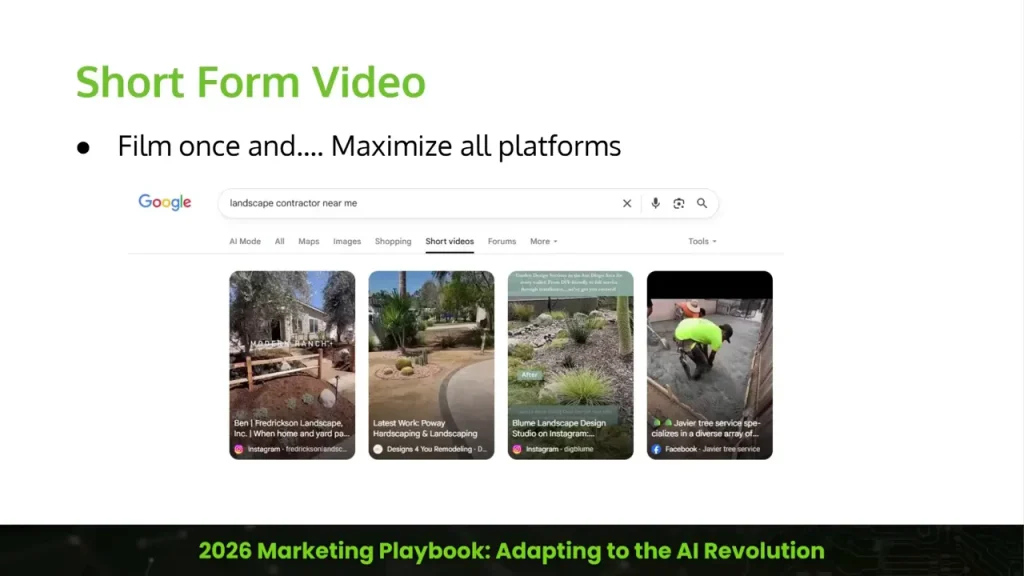
Simple rules for short-form video:
- Shoot phone-quality clips of daily work, before-and-after moments, finished projects,s and customer reactions.
- Keep videos vertical and 15-60 seconds long.
- Add short captions that explain the service, location, and materials (these text cues help AI classify the content).
- Publish consistently to at least one platform – Instagram Reels, TikTok, or YouTube Shorts – then embed the videos on corresponding project pages.
Off-site authority signals: reviews, directories, and mentions
Off-site signals are the evidence AI uses to rank trust and relevance. The more unique, corroborated signals pointing to your business, the better.
- Reviews: – Prioritize Google and Facebook reviews. Request detail in the review (what service, what result) – detailed reviews are more useful to AI.
- Directory listings: – Claim and fill out profiles on Yelp, industry-specific directories, es and local business directories.
- Press and local mentions: – Press releases, local press mentions, on-air appearances, and sponsorships build brand signals and create linkable references.
- Community platforms: – Encourage satisfied customers to mention you on Nextdoor or local subreddits. AI reads community recommendations.
Practical playbook: step-by-step checklist (start here)
Use this checklist to move from planning to results. Pick one thing and get it done this week.
- Audit your NAP: – Search your business name in quotes and note variations. Fix mismatches in GBP and key directories.
- Clean up Google Business Profile: – Add services, business hours, photos, short videos, and respond to reviews.
- Build or enhance service and location pages: – One page per service and one page per major service area. Add schema to each.
- Start a short-form video habit: – Capture one short clip per job day and publish weekly.
- Launch a review campaign: – Ask customers to leave a Google review and, optionally, one on Facebook.
- Claim key directories: – Yelp, industry directories, es, and local chambers of commerce.
- Track leads and conversion: – Tag traffic sources and measure which channels deliver quotes and closed jobs.
How to reverse-engineer competitors and AEO winners
You can learn a lot by inspecting which pages and profiles are repeatedly referenced by AI platforms. Steps to reverse-engineer:
- Query an answer engine for your target keyword plus location (for example, “best landscaper Tacoma”). Note the businesses it lists.
- Look at the sources the engine cites (Perplexity often lists them). Identify the pages, directories, and profiles that appear most often.
- Inspect those pages: what content is present? Service details? Project pages? Videos? Reviews with specific details?
- Fill the same content gaps on your own site and profiles. If winners have embedded short videos and 20+ localized project pages, that’s a playbook to copy and adapt.
Measuring success and optimizing spend
The goal is to generate more qualified leads and achieve higher conversion rates. Track these metrics:
- Number of leads per source (Google GBP, organic site, short video platforms, paid ads)
- Lead-to-quote and quote-to-close conversion rates
- Cost per lead and cost per closed job
- Visibility signals: number of reviews, number of indexed project pages, short videos published per month
Channels need to augment one another. Short video improves brand recognition and click-throughs; strong GBP and reviews improve trust; on-site case studies improve closing rates. Allocate budget where it moves the needle – not just where the clicks are cheapest.
Start small: three prioritized actions for the next 30 days
If implementing everything feels overwhelming, focus on these three priorities:
- Begin short video capture: – 1 clip per job day; publish one per week.
- Fix your Google Business Profile: – ensure NAP consistency, add services, and ask for recent reviews.
- Create or update two project pages: – include photos, a clear description, materials, timeline,e and a customer quote.
Quick implementation tips
- Use your phone. Professional gear help, ps but it is not required.
- Train crews to capture short clips and quick customer reaction shots.
- Standardize review requests: a short script for crews or office staff works wonders.
- Batch content tasks: record multiple short videos in one afternoon and schedule them.
“Answer Engine Optimization is the new SEO you need to master.”
Frequently asked questions
How is Answer Engine Optimization different from traditional SEO?
AEO still relies heavily on on-site SEO, but it adds greater emphasis on distributed and corroborating signals. That means structured data, consistent profiles, and review text, short-form video content, local pages, and community mentions all become part of the ranking mix. The focus shifts from keyword placement to clarity, corroborating, and multi-platform evidence.
Which platforms should I prioritize first?
Prioritize Google Business Profile and short-form video platforms (Instagram Reels, TikTok, YouTube Shorts). Claim Yelp and at least one local directory. Once those are under control, expand to Nextdoor, Reddit, and industry-specific directories for your region.
How important are reviews in AEO?
Very important. Reviews provide real customer language that AI models use as evidence. Ask customers to be specific about the service and results in their reviews, and encourage them to review on Google and Facebook first.
Do I need a separate page for each service and location?
Yes. Create pages for core services and for each service area. Localized pages with specific project examples, photos, and testimonials give AI models clearer signals about what you do and where you operate.
How often should I publish short videos?
Consistency beats frequency at the start. Aim for one posted short video per week and capture daily clips so you have material on hand. Over time, increase frequency to multiple shorts per week as you refine your process.
Can small contractors compete with larger firms in AEO?
Absolutely. Local specificity, strong customer reviews, and frequent short-form content level the playing field. Niche specialization and clear local case studies often outperform generalized content from larger firms.
Final note
The AI revolution changes how discovery happens, but it doesn’t change fundamentals: clarity, credibility, and consistent delivery win. Build clear, structured pages, claim and maintain profiles, capture short videos of real work, and collect detailed reviews. Start with one action this week, iterate,e and measure. Over time, these signals compound – and they tell AI models that your company is the best recommendation for the customers you want to serve.
Implement, measure,e and refine. The businesses that move quickly and consistently will be the ones AI recommends first.

Josh Blakeley
Founder of Landscape & Hardscape Contractor Marketing and author of Backyard Empire. A member of the California Landscape Contractors Association (CLCA), Josh has helped contractors book more high-value jobs through done-for-you marketing built only for outdoor living pros.