2026 GBP & Local SEO Playbook for Landscape Contractors
Google Business Profile is no longer just a directory listing for your landscaping, hardscaping, or outdoor living company. It is becoming a core data source for Google Maps, AI Overviews, Gemini, voice search, and local recommendations.
That changes the game. The businesses that get found are not simply the ones with the oldest websites or the most reviews. They are the businesses giving Google clear, current, consistent evidence of what they do, where they do it, what their work looks like, and why people choose them.
Local SEO Is an Organic Growth Engine
Local SEO sits inside the organic side of your marketing strategy. It works alongside reputation, content, social media, website SEO, and paid lead generation, but it is especially valuable because it helps homeowners find your business when they are actively searching for a contractor.
There is a shift happening in 2026. Google is behaving less like a basic directory of search results and more like an AI recommendation engine. It is pulling together signals from your Google Business Profile, website, reviews, photos, social platforms, and other mentions of your brand to determine which companies best fit a local search.
This is also where AEO, or answer engine optimization, comes in. Traditional SEO helps pages rank in search engines. AEO helps your company and content show up when platforms such as Google Gemini, ChatGPT, Perplexity, and Claude answer questions directly.
Your Google Business Profile Feeds AI Search
Your Google Business Profile is now one of the most important local assets you own. Google uses the information in it to understand your business and potentially recommend it in Maps, AI-generated search results, and voice-based searches.
Google can pull together details from:
- Your business categories and listed services
- Your photos and videos
- Customer reviews and review responses
- Frequently asked questions and Google posts
- Your website service pages
- Your social media profiles
The goal is simple: make your online presence hyper-complete. Your name, services, locations, specialties, products, and branding should be consistent across your Google Business Profile, website, social accounts, and relevant directories.
Landscaping and outdoor living are visual businesses. Homeowners want inspiration. They want to see patios, pavers, retaining walls, outdoor kitchens, pools, pergolas, planting, and before-and-after transformations. Strong visual proof is no longer optional.
Popularity Signals Are Gaining Ground Over Old Authority
A business that has been around for years may still have an advantage, but age alone is not enough. Google is paying close attention to popularity and engagement signals, including what people actually do after discovering your business.
Important signals include:
- Clicks to your Google Business Profile or website
- Phone calls from your profile
- People saving your business
- Direction requests
- Engagement with recent posts, photos, and reviews
- Ongoing activity across your online presence
Direction requests may matter less for a contractor that performs work at clients’ homes, but they are still an engagement signal. The broader point is that Google wants to see evidence that people find your business relevant and worth interacting with.
Freshness matters. A profile that has not been updated in months can look less active than a competitor consistently adding real project photos, job updates, new reviews, and helpful content.
Set a Minimum Posting Rhythm
At a minimum, publish a Google post and add fresh photos to your Google Business Profile every week. The content does not need to be complicated. Use what is already happening in the field:
- Before-and-after project photos
- Current job site progress
- Finished patios, walls, pergolas, pools, or planting projects
- Seasonal service reminders and offers
- New materials, products, or supplier partnerships
- Locations and neighborhoods you serve
- Educational content that demonstrates expertise
Google Can Understand More Than You Think From Photos
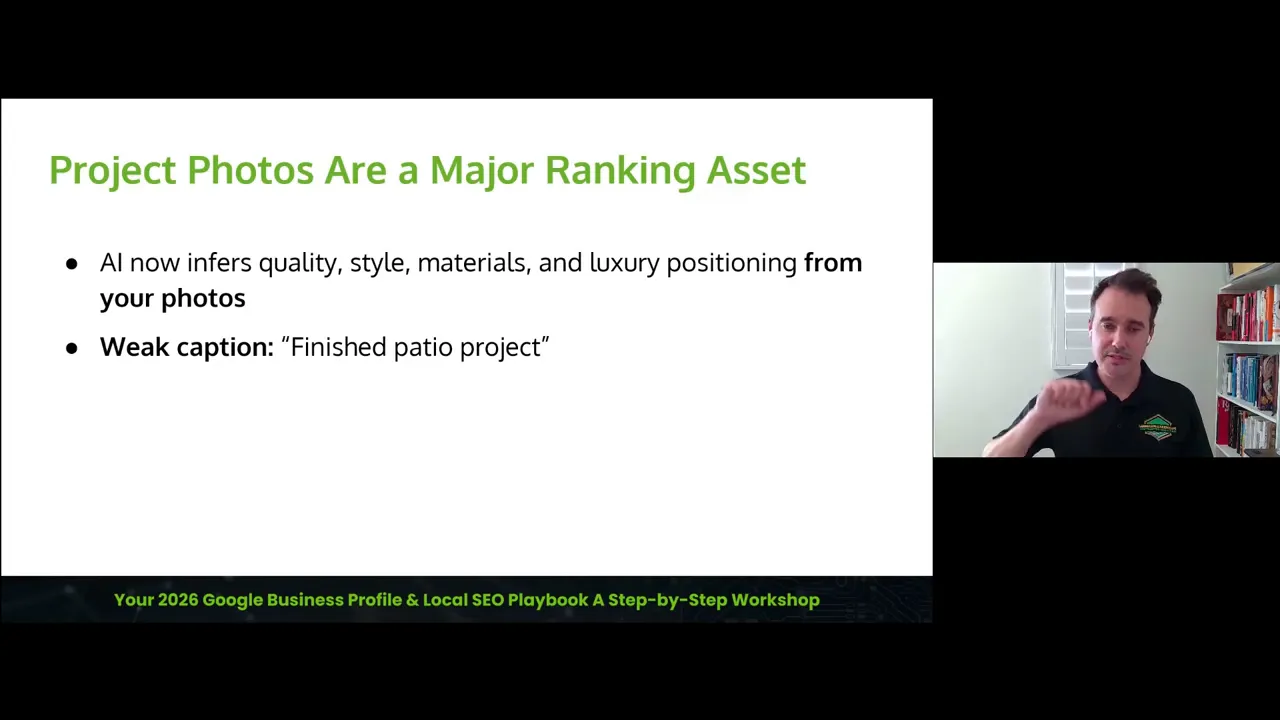
Google’s image analysis is becoming more capable. It can identify features in a project photo, such as retaining walls, pavers, pergolas, and other recognizable elements of an outdoor space. Over time, this ability will only get stronger.
That means every project photo is an opportunity to give Google better context about your work. Do not just upload a nice finished photo with no supporting information. Add useful descriptive detail when posting it on your website, social platforms, and Google Business Profile.
Text overlays can help, too. A simple graphic created in Canva can include clear project information that AI can read. Useful details include:
- The city or neighborhood
- The service completed
- Materials and products used
- Relevant brands or suppliers
- The style of the project
- The outcome for the homeowner
For example, rather than posting a generic patio image, describe it as a paver patio and retaining wall project in a specific neighborhood, noting the material brand and the finished outdoor living outcome. That gives both homeowners and search systems more to work with.
Mirror Your Website Service Pages on Your Profile
Your website and Google Business Profile should tell the same story. Build detailed service pages on your website, then reflect those services inside the profile through the right categories, service listings, posts, photos, and links.
Be specific. Do not stop at “landscaping” if your company specializes in landscape design-build, patios, paver driveways, retaining walls, drainage, outdoor kitchens, pergolas, poolscapes, or landscape lighting.
For every service, include details around:
- The exact service provided
- The locations served
- The materials and products used
- Brands you work with, when relevant
- The type of project or customer need you solve
If you install products from a recognized supplier such as Techo-Bloc, put that information in the relevant website content and profile services where appropriate. Then create a Google post for that service and link it back to the matching page on your website.
This creates a clean connection between the profile, the post, and the deeper service information on your site.
Choose the Right Green Industry Categories
Categories tell Google what type of business you are. Your primary category is a major decision, and secondary categories let you reinforce the full range of work you provide.
For many landscape construction and design-build companies, landscape designer can be a strong primary category. If your business leans heavily into maintenance or broader general landscaping, landscaper may be the better core category.
Then add every legitimate secondary category that applies to your business. The green industry has a number of related options, including categories connected to pools, pergolas, and other outdoor living services.
Do not add categories for services you do not actually provide. The objective is not to look like everything to everyone. The objective is to make it easy for Google to understand your real specialties.
Build Reviews That Actually Help You Rank
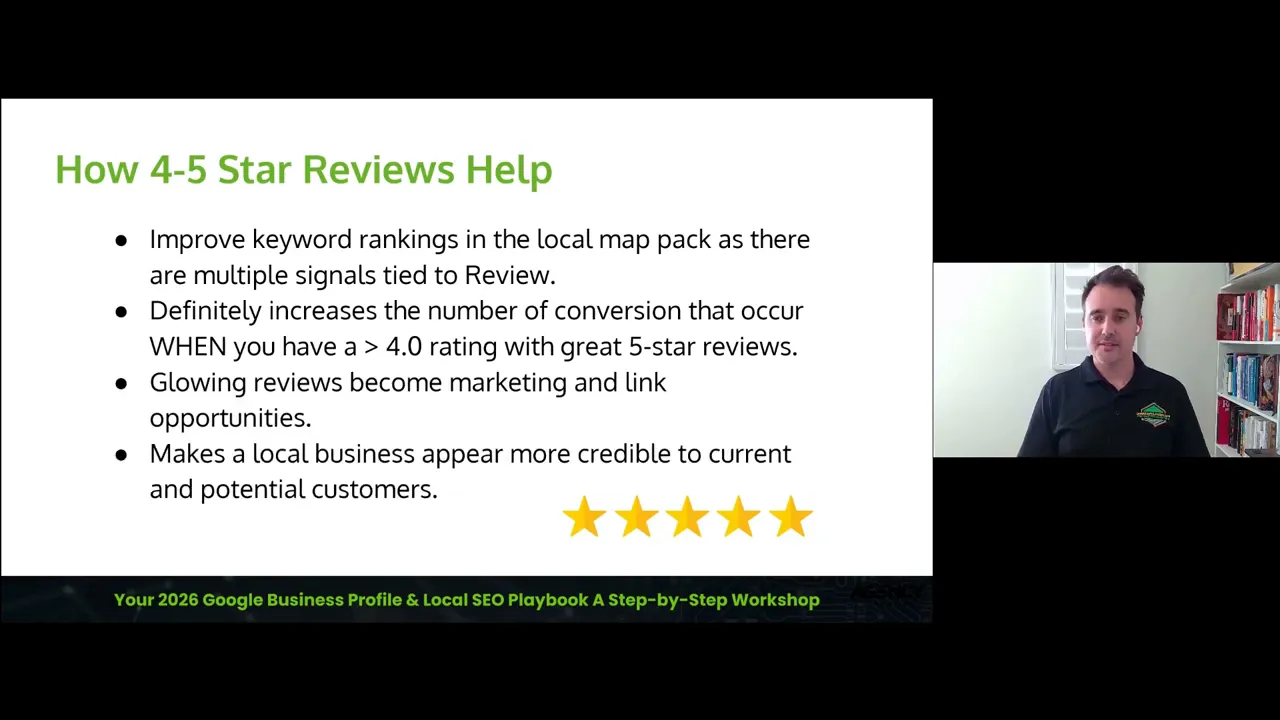
Reviews are not just a quantity game. Review count matters, but so do quality, relevance, recency, and consistency.
Getting to 40 or 50 reviews as early as possible is a worthwhile goal. After that, do not let the process stop. One or two new reviews a month is far more valuable than long periods with no new activity.
Coach customers to write a useful review rather than a one-line compliment. A strong review can cover:
- The problem or goal at the start of the project
- The service your company performed
- The products or materials used
- The city or neighborhood
- The finished result
- The emotional outcome, such as excitement, relief, or confidence in the investment
Photo reviews and short video reviews are especially powerful. They often stand out prominently on a profile and can make a real difference in competitive markets. Keep the content authentic. Use photos and videos of your actual work, not AI-generated project imagery.
Respond to Reviews Consistently
Replying to reviews is another freshness and reputation signal. It also gives you a chance to naturally reinforce the service and location involved. Thank the customer, reference the project where appropriate, and keep the response genuine.
Google can pull specific phrases from reviews based on what a person searches for. Detailed customer language may therefore help your company appear relevant for services, materials, and local areas you want to be known for.
Show Up in AI Overviews With Answer-Focused Content
AI Overviews are changing the path from search to lead. In many cases, Google now provides an answer directly in the search results instead of sending someone straight to a blog article.
That does not mean content has lost its value. It means your content must be built to answer the real questions homeowners ask. When your business is the source that clearly answers those questions, Google can cite or feature it in an AI Overview, often with your business name and a link.
Start by listing common customer questions:
- What does a paver patio installation involve?
- How do retaining walls help with a sloped yard?
- What materials work best for an outdoor kitchen?
- How long does a landscape design-build project take?
- What should a homeowner consider before building a pergola?
Create useful pages and articles around those questions. Then use Google posts to link back to the content. This helps connect your profile with the deeper expertise on your site.
Connect Social Media to Your Google Business Profile
Google has begun surfacing social media content within Google Business Profile results through a social media carousel. That makes consistent social activity more important than ever for landscape contractors.
Connect every active social account to your profile. Keep the business name and branding consistent so Google can correctly associate those profiles with your company.
If an important platform is missing, set it up. Social scheduling tools can make it easier to publish across multiple platforms while making small adjustments for each one. AI can help draft captions, but the raw content should be real projects, real jobsites, and real expertise from your company.
Post beyond generic education. Show the work. Feature the finished project, the materials, the process, the service area, and the result. This creates more ways for people to learn about your business, visit your profile, call, or click through to your website.
What to Post on Social Platforms
- Services and specialties
- Seasonal promotions
- Featured products and materials
- Neighborhoods and cities served
- Before-and-after transformations
- Short project videos
- Practical homeowner education
- Customer feedback and project outcomes
Google Maps Still Matters in an AI Search World
AI is changing search, but Google Maps and Google Business Profiles remain a massive part of local discovery. Local Services Ads may appear first for some searches, followed by map results and other local listings, depending on the device and search configuration.
Relying exclusively on paid ads can become expensive. Building your organic local presence gives you another path to visibility and strengthens the brand over time.
If you have not created a profile yet, begin at **business.google.com**. Verification now commonly requires a video process, especially for businesses that are not already established brands.
Physical Address vs. Service Area: The Local Ranking Reality
A verified physical address is a strong local brand signal and can help a business show more prominently in map results. Service-area businesses can still operate with a Google Business Profile, but a legitimate, verifiable location often provides an advantage.
For contractors working from home who do not want to display a residential address, a small legitimate office in the market you want to serve can be worth considering. One additional job may justify the cost of a modest office space.
However, do not use an address that cannot be legitimately verified or supported. Google increasingly uses video verification and may require evidence such as business signage and a real operational presence. Mailbox and UPS store strategies can be inconsistent, may be denied, and can lead to profile suspension later.
Distance is also a practical limitation. A Google Business Profile generally has a much harder time ranking far from its physical location. In a huge metro area, such as Phoenix, a business on one side of the city should not expect to dominate map results 10 to 15 miles away in another competitive area.
If a particular market is strategically important, a legitimate office in that target area can strengthen your local visibility.
Other Essential Profile Foundations
- Use a local phone number instead of an 800 number.
- Keep business hours accurate and complete.
- Consider an after-hours answering service or AI phone system so inquiries can still be captured outside normal hours.
- Implement on-page SEO and schema markup on your website.
- Keep your business name, address, and phone number consistent everywhere online.
- Use unique location details and phone numbers for legitimate multiple locations.
Strengthen Local SEO Beyond Your Profile
Google Business Profile optimization is not only about what happens inside the profile. Off-page signals help Google connect your business with trustworthy sources across the web.
Useful off-page SEO activities include:
- Press releases that link to your website and profile
- Local chamber of commerce memberships
- Industry and local directory listings
- Community events and sponsorships
- Brand mentions from credible local sources
These activities build links, mentions, and recognition around your company. They also support the trust signals Google looks for when evaluating a local business.
Demonstrate Experience, Expertise, and Trustworthiness
Google evaluates whether a business appears credible and reliable. The practical way to improve those signals is to show real experience, real expertise, and real trustworthiness across your web presence.
Your project photos, detailed reviews, active social accounts, service pages, customer responses, local mentions, and consistent profile information all contribute to that larger picture.
Sync Your Profile to Bing Places
Once your Google Business Profile is built out, create or sync your listing through **bingplaces.com**. Bing Places can sync information from your Google Business Profile and gives your company another local entity for people searching through Microsoft Edge and related search experiences.
It is a simple additional visibility opportunity, particularly when your Google profile is already accurate and complete.
Profile Mistakes That Can Hold Back Rankings
Several avoidable problems can weaken local visibility or create confusion for Google.
Duplicate Profiles
Search your business name and check the back end of your account for duplicate listings. If an old profile exists, remove it or request that Google merge the listings. Leaving multiple competing profiles can split reviews, links, and engagement.
Inconsistent Business Information
If you have rebranded, update your full business name everywhere. Check your website, Google profile, social accounts, local directories, and other listings. Use one consistent core phone number for each location.
Incomplete Services, Categories, and Media
A profile with missing services, few categories, no photos, and little review activity gives Google very little to work with. Complete every relevant section and keep adding real project evidence over time.
Inactive Profiles
No recent photos, no posts, no review responses, and no fresh reviews can make a business look less relevant than an active competitor. Local SEO is not a one-time setup task. It is an ongoing operating system for your online visibility.
A Practical Google Business Profile Audit Checklist
Use this checklist to identify the highest-priority next steps for your landscaping or hardscaping company:
- Claim and verify every legitimate Google Business Profile connected to your business.
- Identify and resolve duplicate listings.
- Choose the right primary category and add all relevant secondary categories.
- Complete service details with specific information about locations, specialties, materials, and products.
- Make sure your website service pages and Google profile match.
- Upload real photos and videos from current and completed projects every week.
- Create weekly Google posts that link to relevant website pages.
- Build a review collection process using Google’s review link or QR code.
- Ask customers for detailed reviews that mention the work, location, materials, and outcome.
- Respond to every review.
- Connect all social media accounts and post consistently.
- Check that your business name, address, phone number, hours, and branding match across the web.
- Build legitimate local links and mentions through chambers, community involvement, press, and directories.
- Sync the profile to Bing Places.
The Bottom Line for Local SEO in 2026
The contractors gaining ground are the ones consistently putting real evidence of their work online. They are not relying on an old website, a handful of reviews, or a profile that was filled out once years ago.
Make your Google Business Profile complete. Keep it fresh. Show the work. Collect detailed reviews. Connect your social platforms. Build local trust signals. Make it easy for Google’s AI systems to understand exactly what you do, where you do it, and why your company is the right recommendation.
That is how you create more opportunities to show up in Google Maps, the local pack, AI Overviews, and the searches that turn into real landscaping and outdoor living projects.

Josh Blakeley
Founder of Landscape & Hardscape Contractor Marketing and author of Backyard Empire. A member of the California Landscape Contractors Association (CLCA), Josh has helped contractors book more high-value jobs through done-for-you marketing built only for outdoor living pros.