Landscape Marketing in 2026: A Priority Playbook for Contractors
More ways to market a landscape or hardscape business than most contractors have the time, budget, or patience to manage. Google Local Services Ads are changing. Homeowners are asking AI tools questions about outdoor projects. Reviews, project videos, search ads, and follow-up systems all compete for attention.
The answer is not to do everything at once. Good landscape marketing starts by identifying the constraint that is costing you the most business, fixing it, and then moving to the next priority.
That is the approach behind this 2026 playbook for landscape, hardscape, and outdoor living contractors. It covers what to put in place first, where paid advertising fits, and how to build marketing assets that keep working after a campaign ends. The underlying question is simple: What will make the biggest difference to your business right now?
Table of Contents
Priority Four: Reactivate the Relationships You Already Have
Make Your Website Answer the Questions Homeowners Actually Ask
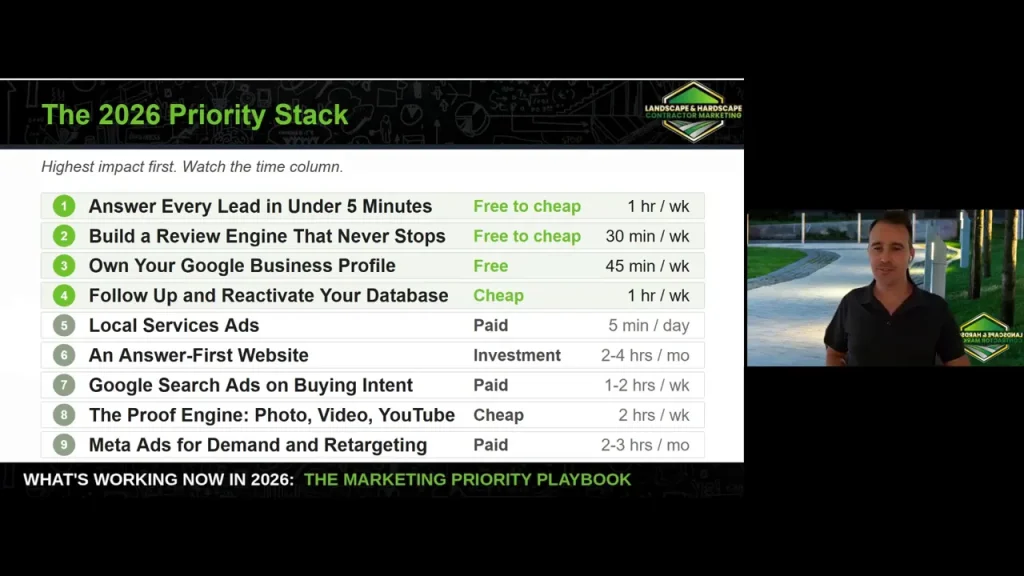
Start With a Priority Stack, Not a List of Channels
A lot of marketing advice is a list of things you could do: run ads, improve SEO, post more often, make videos, collect reviews. None of those suggestions is necessarily wrong. The problem is that they do not tell you what to do first.
I look at each landscape marketing opportunity through four practical lenses:
Cost: What will it take to set up and maintain?
Time: How much work does implementation require?
Impact: How much could it improve the business?
Speed: How soon might you see a result?
Cheap and easy are not the same thing. Personally following up with customers for reviews may cost very little, but somebody still has to own the process. A professionally managed ad campaign costs more, yet it may be a better use of an owner’s time than trying to master the platform between job sites.
The priority stack begins with the leads and assets you already have. Answer inquiries quickly. Collect fresh reviews. Get your Google Business Profile right. Stay in touch with past customers and prospects. Then build stronger proof, improve the website, and scale through paid channels.
This is not an argument against advertising. It is an argument against paying for more inquiries while your existing inquiries go unanswered. Fixing that leak can improve the return from every channel you run afterward.
Get the Foundations Right Before You Scale
Even in 2026, I still speak with contractors who are missing basic pieces of their business setup. These may not sound as exciting as AI search, but they support the credibility, tracking, and consistency that effective landscape marketing needs.
Use a Professional Email Address and Track Calls
An email address connected to your business domain is a straightforward credibility upgrade over a personal Gmail address. Google Workspace is one accessible way to set that up. It is not a growth strategy on its own, but it helps your business look established when a prospective customer gets a reply.
Call tracking is more consequential. If you do not know which inquiries came by phone, which were answered, and what happened afterward, you are missing a large part of the picture. Connect those calls and your other inquiries to a customer relationship management system, or CRM, so you can follow the path from first contact to booked appointment to sold job.
That information also gives you something useful to analyze. AI tools can help you examine call patterns or sales conversations, but only if you are collecting the underlying data. More information about your own business means better questions and more useful feedback.
Keep Your Business Details Consistent
Your business name, address, and phone number should match across your website, Google Business Profile, major social profiles, and established directories. In landscape marketing, this is often called NAP consistency. It has long mattered for local search, and it remains important as AI-powered tools gather business information from multiple places.
Start with your website and Google Business Profile. Next, check your main social accounts, then the directories people and search platforms are likely to reference. If your phone number changes, update it everywhere rather than leaving conflicting listings behind.
A genuine business address can also add credibility and may help local visibility. If you have an office that customers can visit, use accurate details. If your business operates from home, make sure your profile reflects how you actually serve customers and follows Google’s applicable rules. The goal is a trustworthy business presence, not an address that misrepresents your operation.
Make the Worksite Part of Your Marketing
Your online presence is only one side of your marketing landscape. A branded truck, employee shirts, and a yard sign at an active project all help people connect the work they see with the company doing it. You are already on site. Make it easier for neighbors and passersby to remember your name.
Some of these items involve an upfront cost, but they can keep working across many jobs. They also reinforce what a homeowner finds later when they search for your business online.
Priority One: Answer Every Lead Within Five Minutes
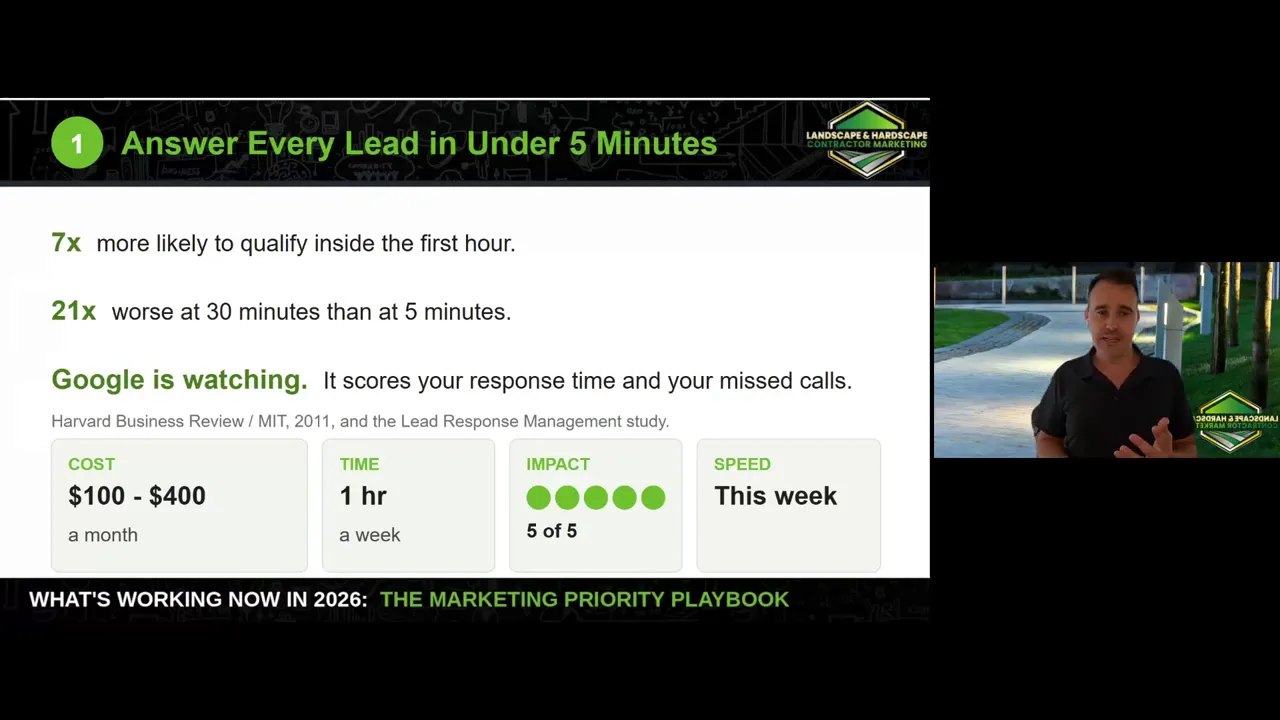
If I had to choose one change for a contractor who wants more sales from current landscape marketing, this would be it: respond to every new lead as fast as you reasonably can. Aim for under five minutes.
A homeowner reaching out about a patio, landscape design, or outdoor living project wants communication as much as craftsmanship. If they can’t reach you, a beautiful portfolio won’t solve the immediate problem.
The research figures in this playbook point to a steep drop-off as response time increases: leads are far more likely to qualify when contacted within the first hour, and the gap between five minutes and thirty minutes is especially stark. The operational takeaway is more important than memorizing a multiplier. Speed should be a system, not luck.
Here is the minimum standard I would build around:
Send calls to a person during business hours. Decide who answers and who covers when that person is unavailable.
Notify your team immediately when a form arrives. Text and email alerts help keep an inquiry from sitting in an inbox.
Acknowledge the homeowner’s inquiry. An automated response can confirm that someone will call and, where appropriate, offer a way to continue the conversation or book a time.
Record the outcome in your CRM. You need to know whether you reached the lead, qualified them, booked them, and eventually sold them.
Consider a missed-call text-back feature if your CRM offers one. If answering the phone remains a persistent problem, an AI voice system may provide additional coverage. Neither should become an excuse to stop having real conversations. The goal is to keep an interested homeowner from hitting a dead end.
This matters particularly when you use Local Services Ads. Responsiveness affects the customer experience, and Google pays attention to how businesses handle inquiries on the platform. Before increasing your ad budget, make sure someone can answer the calls it generates.
Priority Two: Build a Review Engine That Never Stops
Reviews are not a project you complete once and forget. They need to be part of your normal customer process.
A large number of old reviews can help establish a track record, but freshness and consistency matter more for local visibility. That makes review collection an ongoing landscape marketing responsibility rather than a push you make only when a competitor moves ahead.
In this industry, I favor a personal request over relying entirely on automated follow-ups. You have spent time working with a client, solving problems, and building an outdoor space together. Use that relationship. Ask them directly about the experience while the details are still fresh.
One way to make the request easier is to interview the customer briefly. Ask what they wanted to change, how they found the process, and what they like about the finished project. Write up what they said, send it back for their approval, and let them edit it. That gives them a starting point without putting words in their mouth.
Where you can, connect the review to photos or a short testimonial video. The written feedback tells people what the experience felt like. The visuals show what your team delivered. Together, they become much more useful proof for your website, ads, and social channels.
Start by maintaining a steady flow of Google reviews. After that, Yelp is another review platform worth paying attention to, especially because it is referenced beyond its own site. Do not spread your team thin trying to collect feedback everywhere at once. Make the primary process reliable, then extend it.
Priority Three: Own Your Google Business Profile
Your Google Business Profile is a free asset, but free does not mean optional. For local landscape marketing, it is one of the first places to check when your company is not showing up the way it should.
Categories deserve particular attention. For a landscape design-build firm, landscape designer is a strong primary category, with landscaper as another close option for a full-service company. Other categories may fit businesses with a different service mix. Choose based on what you actually do, not by copying another contractor’s profile.
Then keep the rest of the profile useful. Add photos of completed work, and make sure the business details match your website and other listings. This is a visual industry. A homeowner considering a substantial backyard project wants to see real examples, not just read a list of services.
Reviews, categories, accurate contact information, and project photography reinforce one another. None requires you to launch a new paid campaign, which is why the profile sits so high in the priority stack.
Priority Four: Reactivate the Relationships You Already Have
Many contractors spend heavily to find new people while doing very little with the contacts they have already earned. A CRM gives you a place to keep those relationships organized. The next step is to stay in touch without becoming a nuisance.
Share recent projects and a little context about them through an email newsletter. A past customer may not need another backyard immediately, but they can still remember your work or pass your name to someone else. A prospect who wasn’t ready six months ago may be ready to talk now.
Occasional follow-up about a relevant offer can also make sense. Email is a relatively accessible way to do it. Text messaging is another possibility, but it needs more care. A useful update from a company someone knows is very different from a stream of messages that feels like spam.
Good database reactivation is not a substitute for finding new customers. It is a way to stop overlooking an existing landscape marketing asset: people who already know your name.
Build a Proof Engine From Every Project You Can
Once you control the immediate leaks, start building a repeatable process for gathering photos, videos, and customer stories. I call this a proof engine. It takes work, but the same material can strengthen almost every part of your landscape marketing.
Think beyond a single finished-project photo. Capture the project as it progresses where practical. Explain the customer’s goals, show relevant work details, and document the result. If the customer is willing, add their experience in their own words.
You can use that material on your website, YouTube, and shorter-form social platforms. It can support paid ads and email updates. It can also help a homeowner understand how you operate before they ever call.
YouTube is especially useful because it serves multiple purposes. It gives your project content another place to be found, provides material you can embed on a service or project page, and gives you something substantial to share with your database. The same video may introduce your company now and build trust with a future customer months later.
You do not need to produce a major film for every job. You do need a process that makes collecting authentic evidence normal rather than an afterthought. If capturing quality video is beyond your team’s available time or skill, paying someone to help can be a sensible part of the budget.
Make Your Website Answer the Questions Homeowners Actually Ask
Search behavior is changing. People still search for services, but they also ask Google and AI platforms detailed questions about processes, costs, materials, warranties, and who is right for a particular project. Your website should be ready to answer them.
An answer-first website is not a collection of generic pages stuffed with keywords. It explains your business clearly enough that a homeowner can understand what you do, where you do it, and what it’s like to work with you. That is good landscape marketing whether the person discovers your page through a traditional search result or an AI-generated answer.
A useful starting point is an in-depth interview with the owner or team. Ask about:
How the business started and what kinds of projects it takes on.
What happens from the first inquiry through design and construction.
How the team approaches communication and job-site work.
What warranties or promises the business offers.
Which suppliers it works with and why those choices matter.
What the team is proudest of in its completed projects.
Which customers are a good fit and which projects are not.
From there, organize the answers into useful service pages, process explanations, project stories, and social content. AI can help break an interview into drafts, but the substance should come from your actual business. A polished paragraph that says nothing specific will do the same work as an honest explanation of your process.
Technical SEO matters too, including appropriate schema markup. But don’t let technical work become a reason to leave basic questions unanswered. The fundamentals of SEO and AI-oriented search overlap: clear services, accurate local information, credible proof, and useful content still matter.
Prepare for Changes to Local Services Ads
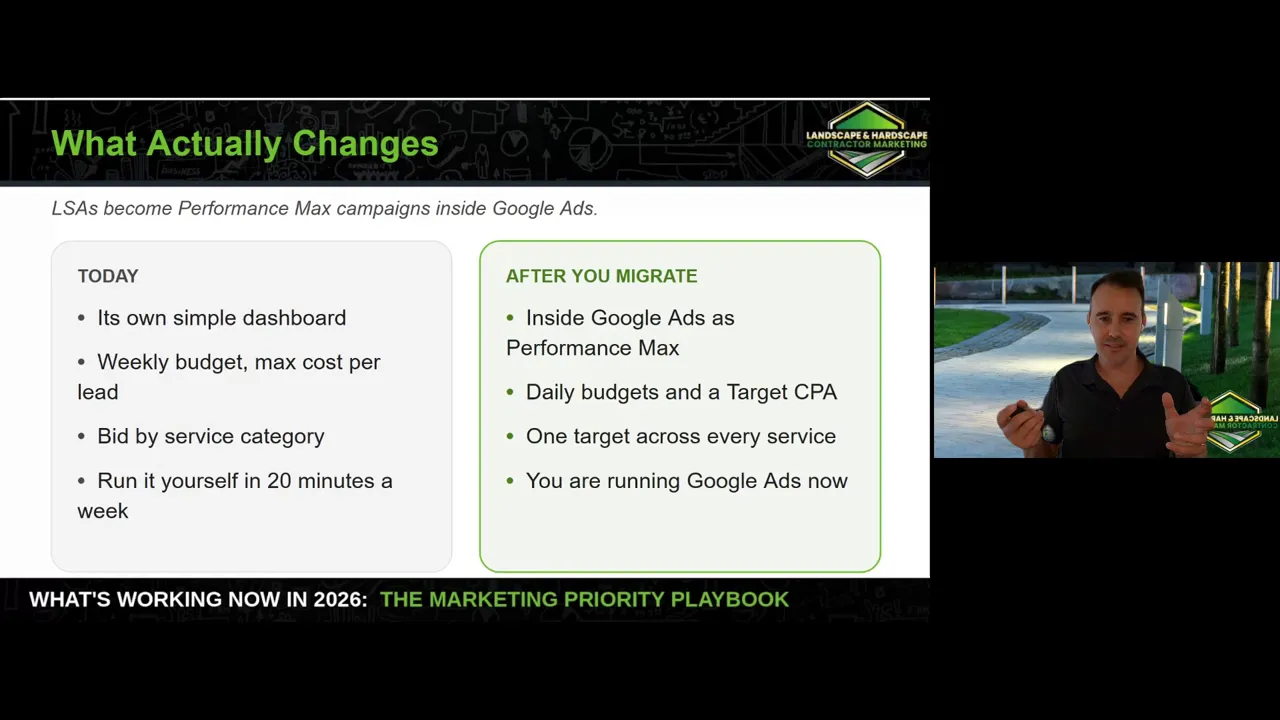
Google Local Services Ads, or LSAs, are a priority paid channel for many contractors because they connect you with people actively looking for a service. As of the August 2026 update discussed here, the LSA management experience is moving into the broader Google Ads platform. Manual bidding is also being phased out in favor of Google’s automated approach.
If you currently run LSAs, take practical steps before your familiar dashboard goes away:
Export your existing reports. Keep a record of past lead and campaign performance.
Get familiar with Google Ads. Do not wait until you need to make a change under pressure to learn where things are.
Keep your reviews and response process in good shape. A new interface doesn’t change the importance of trust and fast follow-up.
Monitor how the transition affects your account. Check what data remains available and how your campaigns are managed after migration.
The longer-term opportunity is better feedback from your sales process. If you can connect booked appointments and sold jobs in your CRM back to the ad platform, Google has more useful information than a raw lead count. A lead that becomes a profitable project is more valuable to your business than an inquiry that was never a fit.
You need to test how those connections work as the platform changes. The landscape marketing principle remains the same: measure outcomes as far down the sales process as you can, rather than judging a channel only by how many calls it generates.
Use Google Search Ads Carefully
Google Search Ads can capture strong intent, but they can also spend a budget quickly if the campaign is too broad. This is not a channel I recommend setting up casually and leaving Google to manage without clear controls.
Be especially careful with broad-match keywords unless you have the conversion data and a strong negative keyword list to support that approach. Exclude searches that don’t fit your business, such as cheap repairs or do-it-yourself inquiries, when you are trying to sell substantial design-build projects.
Do not send a service-specific ad to your homepage. If someone searches for a particular service, send them to a page built around that service. They should immediately understand what you offer, see relevant proof, and have a clear way to inquire.
I am also cautious about relying on a Google Smart campaign as an unattended landscape marketing solution. If you are not prepared to manage search campaigns properly, LSAs may be the more appropriate place to start. They aren’t guaranteed to deliver leads, but a poorly controlled search campaign isn’t a shortcut to predictable growth.
As with LSAs, connect advertising to real business outcomes where you can. Feed back booked appointments and sold jobs, not just form fills. Then you can make decisions based on lead quality and revenue, not a dashboard number that looks good in isolation.
Make Meta Ads Feel Like Your Business
Meta ads work differently from Google Search Ads. Someone searching Google may already be looking for a landscape contractor. On Meta, you are trying to earn attention before that same clear intent exists.
That changes the creative. In our experience, authentic video often works well: a contractor explaining how the team operates, showing a project, or talking through what happens on a job site. It should feel like a real business sharing real work, not an ad assembled from generic claims.
Meta also requires stronger pre-qualification. Interest is not the same as readiness to buy. Use a lead form or a dedicated landing page to ask questions that help determine whether the project fits your services. Without that step, you can generate activity without generating the opportunities your team actually wants.
The proof engine supports this channel directly. Good project footage gives your landscape marketing something genuine to say. Pre-qualification helps protect your team’s time. Missing either piece can make the campaign more expensive and the leads less useful.
Set a Growth Budget You Can Explain
Contractors often ask what they should spend on marketing. No single number fits every business, but for a company pursuing growth, I’d use roughly 7% to 8% of revenue as a planning guideline. A business focused on maintaining its current level may choose to spend less.
That is a budget to evaluate against your margins and goals, not a promise that any particular spend will produce a particular project. A $50,000 backyard is meaningful revenue, but revenue is not profit. Know what a sold job contributes before using it to justify an advertising investment.
For many outdoor living contractors, I would prioritize the budget in this general order:
Protect the foundation. Maintain the website, local visibility, lead handling, reviews, and CRM.
Capture existing search intent. Use LSAs where they perform, then consider properly managed Google Search Ads.
Build reusable creative. Fund project photography and video if your team cannot consistently capture it.
Expand into attention-based channels. Use Meta when you have authentic material and a way to qualify leads.
You may not spend every dollar allocated to a search campaign if you manage it strictly. That is fine. Unspent budget is better than paying for irrelevant clicks. You can redirect it to another landscape marketing opportunity once the fundamentals are working.
The Math Behind Fixing Follow-Up First
Here is a simple illustration of why the top priority matters. Suppose your business receives 30 leads and closes 20%. That is six jobs. Improve the close rate to 30% with better response and follow-up, and the same 30 leads produce nine jobs.
At an average project value of $12,500, those three additional jobs represent $37,500 in additional revenue. That is not $37,500 in profit, and better follow-up alone does not guarantee that change. It shows why improving conversion can be worth more than simply buying another batch of leads.

Track your own numbers. How many inquiries came in? How many received a timely response? How many became appointments, proposals, and sold jobs? Once you know where people drop out, your next landscape marketing decision becomes much clearer.
Decide Who Will Actually Do the Work
A plan only has value if somebody implements it. That might be you, someone in-house, or an outside partner. Each option costs more than the number on an invoice.
Doing it yourself means accounting for setup, weekly management, and the time required to learn each platform. Hiring in-house gives you dedicated capacity, but you need to consider salary and whether one person has the skills to handle everything from creative production to ad management and tracking.
A marketing partner is another option. For a high-quality partner, a rough monthly range discussed here is $2,500 to $10,000, including ad spend, depending on what is involved. That range is context for planning, not a quote for every business.
I run a marketing company, so I am open to sharing my perspective on that comparison. The useful exercise is to put the real numbers side by side. Consider the work required, the expertise available, and the owner’s time. The cheapest-looking choice is not necessarily the most economical way to run landscape marketing.
A Practical 90-Day Plan: Fix, Build, Then Scale
You do not need to implement this entire playbook next week. Divide the next 90 days into three stages so each improvement supports the next.
First: Fix the Leaks
Start with the lead path. Test your phone and website forms. Confirm who receives notifications, who responds, and what happens after a missed call. Set a five-minute response target during the hours you can support it, then track whether you meet it.
At the same time, check your Google Business Profile, business contact details, and review process. These foundational landscape marketing tasks directly connect to visibility and trust.
Next: Build the Assets You Already Have Access To
Organize your CRM contacts and plan useful follow-up. Gather project photos and videos. Talk with customers willing to share their experience. Interview your team about the process and turn those answers into clearer website content.
This stage gives you material to use across search, email, YouTube, and ads. It also makes your business easier to evaluate before someone contacts you.
Then: Scale What You Can Measure
Once you handle inquiries promptly and have proof in place, review your paid channels. Prepare for the LSA platform changes. Tighten Google Search Ads around relevant services and landing pages. Test Meta creative with meaningful pre-qualification.
Measure appointments and sold work, not just leads. Choose the next landscape marketing investment based on the results your business can actually see.
What Not to Do
A few mistakes are worth calling out because they undo otherwise good work:
Do not add lead channels to compensate for broken follow-up. Fix the response problem first.
Do not chase AI search while neglecting basic SEO. Accurate business details, strong pages, and useful content support both.
Do not treat reviews as a one-time campaign. Build a consistent, personal request process.
Do not send service ads to a generic homepage. Match the page to the inquiry.
Do not assume you must manage every channel yourself. Be realistic about your team’s available time and expertise.
These aren’t complicated rules, but they require discipline. Most landscape marketing gains do not come from finding one secret platform setting. They come from making the basics work together: prompt communication, visible proof, clear answers, accurate tracking, and a sensible order of operations.
Pick the top one or two priorities your business has not handled well. Implement those before you move down the stack. That is how you stop paying to fill a leaky bucket and start building a marketing system that can support the next stage of growth.

Josh Blakeley
Founder of Landscape & Hardscape Contractor Marketing and author of Backyard Empire. A member of the California Landscape Contractors Association (CLCA), Josh has helped contractors book more high-value jobs through done-for-you marketing built only for outdoor living pros.