Landscape Marketing in 2026: Use AI to Turn More Leads Into Signed Contracts
Call your business number at 6 p.m. tonight. What happens?
If the call goes to voicemail and nothing else happens, that is a landscape marketing problem. You may have done the work to earn a recommendation, publish projects, collect reviews, and generate an inquiry. But when a homeowner is ready to talk, your business gives them no clear next step. They can call the next contractor before you even know they were interested.
AI is changing how people find landscape, hardscape, and outdoor living contractors. It is also changing how businesses answer inquiries, follow up, and learn which ads produce actual jobs. None of that replaces the relationship between a homeowner and the person they trust with their project. The opportunity is to use the technology around that relationship, so fewer good opportunities fall through the cracks.
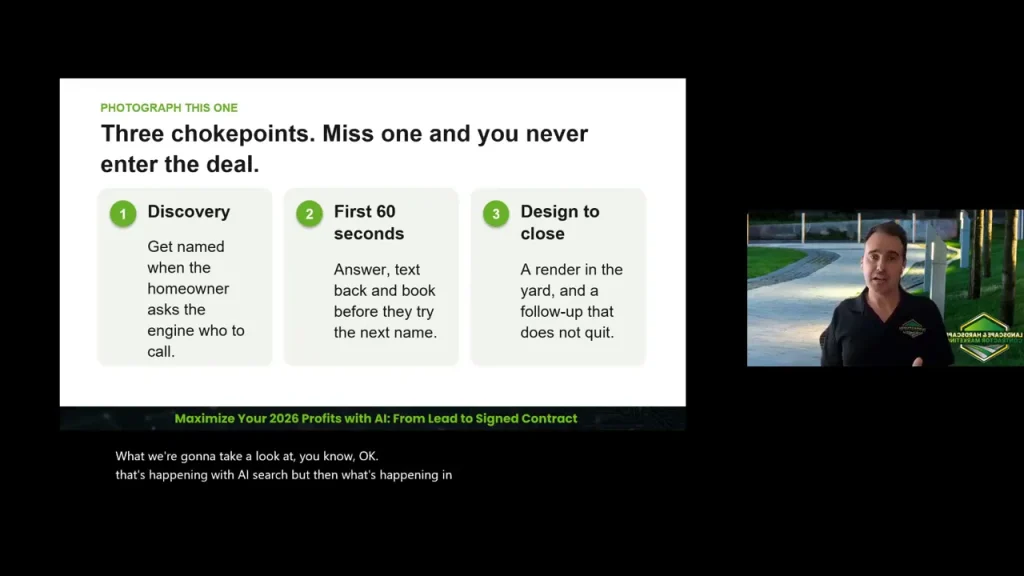
The path is straightforward: get discovered, make the first contact count, and follow through to a signed contract. Here is how to build that path in a sensible order.
Table of Contents
Landscape Marketing Now Runs From Discovery to the Close
It is tempting to judge marketing by how many leads arrived this month. That number matters, but it does not tell you enough. You need to know what happened to those leads after they found you.
Think of the customer journey in three connected stages:
Discovery: A homeowner researches a project and decides which contractors are worth contacting.
First contact: They call, fill out a form, or use a pricing tool. Your response shapes their first direct impression of the business.
Estimate and close: You qualify the project, build a relationship, provide an estimate, and follow up until a decision is made.
A weakness at any stage affects the others. Better search visibility will not do much for profits if inquiries sit unanswered. A fast response cannot rescue a business that never appears during the homeowner’s research. And a booked estimate is not a sold job if nobody owns the follow-up.
That is why landscape marketing needs to be connected to the sales process. The question is not simply, “How do we get more leads?” It is, “How do we turn more of the right inquiries into projects we actually sell?”
What Has Changed About How Homeowners Find Contractors?
Homeowners can now ask AI tools for recommendations instead of sifting through a long list of search results. They can describe the project in ordinary language, ask follow-up questions, and request contractors in their area. Talking to an AI tool on a phone makes that kind of detailed research even easier.
A BrightLocal figure discussed in the workshop puts consumer use of AI tools to find local businesses at roughly 6% to 45%, depending on the measure. The useful takeaway for a contractor is not to assume every homeowner searches the same way. Instead, recognize that AI-assisted local research is already part of the discovery process.
These tools may name just one, two, or three businesses and explain why each one fits. If you are missing from that short list, the homeowner might never reach your website or call you. Your landscape marketing must give search and AI platforms enough current, specific information to understand what you do and why you are a credible choice.
Fresh reviews help people trust a current business
Reviews are not just a lifetime total. Homeowners want evidence that you are doing good work now. The discussion cites a figure of 74% regarding the importance of review recency and focuses particularly on reviews from within the last 90 days.
A large collection of old reviews is valuable, but it should not be the end of your review process. Make requesting feedback a regular part of finishing a job. Your CRM can prompt the request, while a personal conversation gives you the chance to ask a happy client directly.
For substantial projects, take the extra time to collect more than a rating if the customer is comfortable with it. A written account of their experience is useful. A video testimonial in which they describe the project and what it was like to work with your team can be even stronger. It gives future customers a real person and a real outcome to connect with.
Good landscape marketing does not end when the crew finishes. The finished job is your next piece of proof.
Show finished work and answer real project questions
AI tools need material they can reference. So do homeowners. Put photos, videos, and descriptions of completed projects where people can find them, especially on your website. Explain what the project involved and the kind of work your business performed.
Pricing deserves attention too. People ask what a project may cost before they contact a contractor. If every relevant page stops at “contact us for pricing,” you leave that question unanswered during the research stage.
Where you can, add honest starting prices or price ranges to project pages. A range is not a promise that every job costs the same amount. It gives someone a useful starting point and helps them decide whether the project and your business may be a fit.
That information can also help with your Google Business Profile posts and social content. The goal is consistency: show the work, explain the service, and address the questions people repeatedly ask. Those are stronger landscape marketing assets than a site filled with generic claims.
AI can help you turn project notes into a first draft of a page or post. Tools such as Claude, ChatGPT, and Gemini can work from information about your business and brand voice. But you still need to decide the job details, pricing, and final copy. Publish something that reflects how your company actually works.
Make sure AI tools can access your website
Discovery also has a technical side. If your website blocks the crawlers an AI platform uses to read pages, the platform may not be able to consider the information you have published. Check whether important pages are accessible and whether the site has the technical setup, including relevant schema, to help platforms understand its content.
Do not mistake that for a shortcut. Technical accessibility matters, but an accessible site with little useful content still gives a platform little to work with. Build the project pages, pricing information, service explanations, and proof first. Then make sure the technical setup lets people find and understand those assets.
Paid Landscape Marketing Still Depends on Proof and Fresh Creative
Google and Meta remain major advertising platforms for this industry. The mechanics change, but the fundamentals still connect back to your business: reviews, relevant content, a clear offer, and a way to recognize a qualified lead.
Google Local Services Ads are moving toward closer integration with the main Google Ads dashboard and Performance Max. Rollout details can change, so contractors already using Local Services Ads should watch how their accounts are managed. Don’t assume a setup you learned once will stay exactly the same.
Reviews and business information have been important for Local Services Ads and remain worth maintaining. If you run ads yourself, understand the platform you are spending money in. If someone manages it for you, ask them what is changing and how they are handling it.
On Meta, one of the clearest landscape marketing opportunities is to keep the creative fresh. You already produce new material when you finish projects. Use it:
Show a recently completed landscape, hardscape, or outdoor living project.
Share a customer video testimonial when the customer agrees.
Record a founder video explaining your values and how you work with clients.
Show the people and process behind the finished result.
A customer speaking about their own experience is especially compelling because it combines the project with trust. Fresh creative helps bring people in, but what happens next still matters. An ad should lead into a qualification and response process, not an inbox nobody checks.
Know where your last three sold jobs came from
Here is a quick test of your current landscape marketing: where did your last three sold jobs originate?
Not your last three leads. Your last three sold jobs. Did the first inquiry come through an ad, local search, or another source? Did it become a booked estimate? Who followed it up? If you can answer those questions from your CRM, you can make better decisions about where to spend your time and money.
If you cannot answer them, start tracking. A channel that produces many form fills may not be the channel producing signed contracts. You need the whole path before you can judge performance.
The First 60 Seconds Are Part of Your Sales Process
When a serious homeowner reaches out, they may be ready to book an estimate or talk through pricing. The first minute of contact tells them something about your business before a salesperson ever presents a design.
Did a person answer? If not, did they receive a useful response? Do they know what happens next? A clear, professional first interaction can build enough confidence that they feel less need to keep calling other contractors.
This applies whether the inquiry arrives by phone, form, or a price estimator on your site. The phone is a particularly revealing place to start because the gap is easy to miss: the business owner is busy, the call ends, and the opportunity is gone unless a system records it and prompts a response.
“Machine versus machine” is already a practical issue
AI is appearing on both sides of the call. Google Local Services Ads can use AI to assess calls, including how a business responds and whether an inquiry relates to its services or service area. Automated systems have also called businesses for information, and AI tools are beginning to make inquiries on customers’ behalf.
Meanwhile, contractors can use AI answering tools through CRM and phone systems. That does not mean a machine should take over every conversation. It means your landscape marketing and intake process must account for a world in which calls may be assessed automatically, and customers expect a useful response.
The right question is not, “Can AI answer everything?” It is, “What happens when my team cannot pick up, and how quickly does the right human get involved?”
Build a Speed-to-Lead System With a Human at Its Center
The best setup covers multiple response levels. A receptionist or salesperson who can answer a real inquiry during business hours is valuable. Automation backs that person up; it should not become an excuse to disappear from the conversation.
Here is the practical stack, starting with the simplest protections.
Filter robocalls without losing real inquiries
Spam calls waste time and make it harder to spot genuine customers. One option is to require callers to press a key before the call connects. That simple step can filter out many robocalls while letting a real person through. An AI voice at the start of a call may also help filter.
Whichever method you choose, test it yourself. The goal isn’t just fewer interruptions. It is fewer interruptions and a clear path for legitimate inquiries.
Set up missed-call text back as a minimum safeguard
If a call goes unanswered, an automatic text can acknowledge it and give the person a way to respond with what they need. Most CRMs let you set up this kind of missed-call response.
That text is a safeguard, not your ideal sales process. Someone who called to discuss a significant project wanted a conversation. A text is better than silence, but it should trigger a timely human follow-up.
Use an AI receptionist when your team is unavailable
An AI receptionist can do more than send a generic acknowledgment, especially after hours. It may ask about the project, collect contact information, explain the next step, book a time to speak with a person, or notify your sales team that someone needs a callback.
This gives the lead a process to engage with instead of a voicemail box with no indication of when they will hear back. It can also introduce how your company works while you are unavailable.
Be realistic about the limits. An AI receptionist does not bring the full human component to a conversation about a $10,000, $20,000, or $30,000-plus project. It helps you avoid dropping the inquiry and gets the right person into the conversation sooner.
Aim for a human callback within five minutes
When you cannot answer immediately, aim to have a person call back within five minutes. Communication is a major part of the customer experience in this industry. Prompt contact shows that your business follows through.
If you book calls through a calendar, make the appointment and the next step clear. Send reminders to the homeowner and the salesperson so neither side has to guess. A booked conversation is also a more meaningful signal for your marketing than an unqualified form fill.
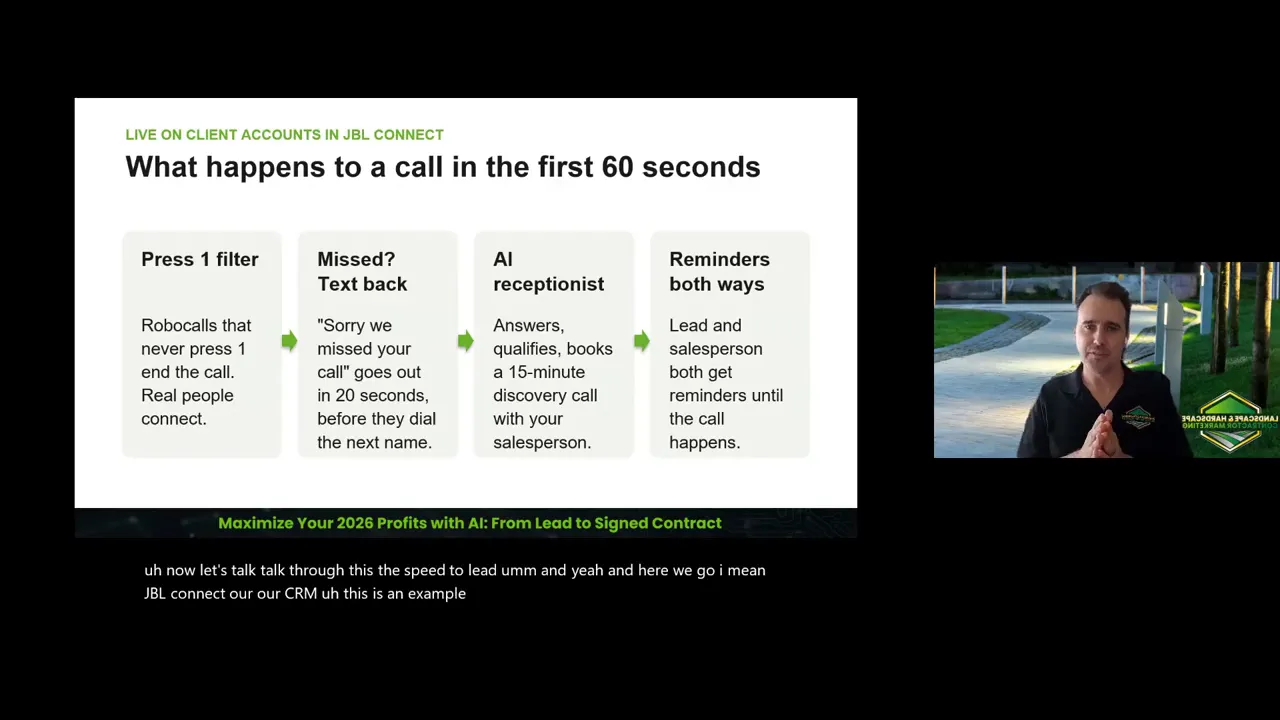
The result should feel organized, not robotic. The customer knows someone received their inquiry. Your team knows who needs a response. And someone is still responsible for earning the job.
Run the 6 p.m. test
Call your own business number after 6 p.m. and pay attention to the whole experience. Does anyone answer? Does an AI receptionist ask useful questions? Does a missed-call text arrive? Can you book a conversation? Does anyone follow up?
Then look at what the caller receives before speaking with a salesperson. Do they get information about your process or examples of work you have done? Do they have a reason to trust that the next step is coming?
If the only outcome is voicemail, you have found a clear place to improve your landscape marketing. You don’t need to redesign every ad or website page to fix that gap.
Follow Up Without Becoming Pushy
A homeowner who doesn’t respond right away isn’t necessarily uninterested. People get busy. A project may take time to discuss at home. They may be comparing options or waiting to understand their budget.
That is where a planned follow-up sequence helps. Rather than sending repeated versions of “Are you ready yet?”, use the touchpoints to answer questions and show what it is like to work with you. A ten-touch sequence can draw on:
Your business process and what happens after an initial conversation.
Relevant completed projects, including photos or videos.
Client testimonials and reviews.
Clear reminders about a booked call or estimate.
The next step after you send an estimate.
Email can carry much of this information, with text messages used where they make sense. Your CRM can make the sequence repeatable so every inquiry gets a consistent experience. AI can help draft and refine messages, especially when it has accurate information about your business.
But do not automate away the relationship. A salesperson should know which conversations need a personal reply. After an estimate goes out, the customer should understand the dates and next steps, and your team should know who is responsible for following up.
Messages can come from the person the customer has spoken with. That person can also follow up manually, which is often the best touch of all. More advanced AI responses may have a place, but they should support a trustworthy, informed conversation, not pretend a relationship exists when nobody is paying attention.
Teach Your Ads What a Good Customer Looks Like
Many contractors have felt the frustration of paying for leads that turn out to be poor fits or price shoppers. Some of that is an intake and qualification issue. Some of it is a feedback issue.
Google and Meta can optimize toward the signals you send them. If the only signal they receive is “someone filled out a form,” you are teaching them to look for more form fills. Your landscape marketing needs a better definition of success.
Start by distinguishing an inquiry from a qualified opportunity. A form or call can gather information about the project, service area, homeownership, and timeline. Someone who isn’t ready may still be worth keeping in an educational follow-up sequence, but you shouldn’t treat them the same as someone ready to book an estimate.
From there, give the platforms progressively better information:
Initial inquiry: A person calls or submits a form.
Qualified lead: Your team or process confirms that the project is a potential fit.
Booked estimate: The person takes a meaningful step toward discussing the work.
Sold project: A contract is signed, ideally with the project value recorded.
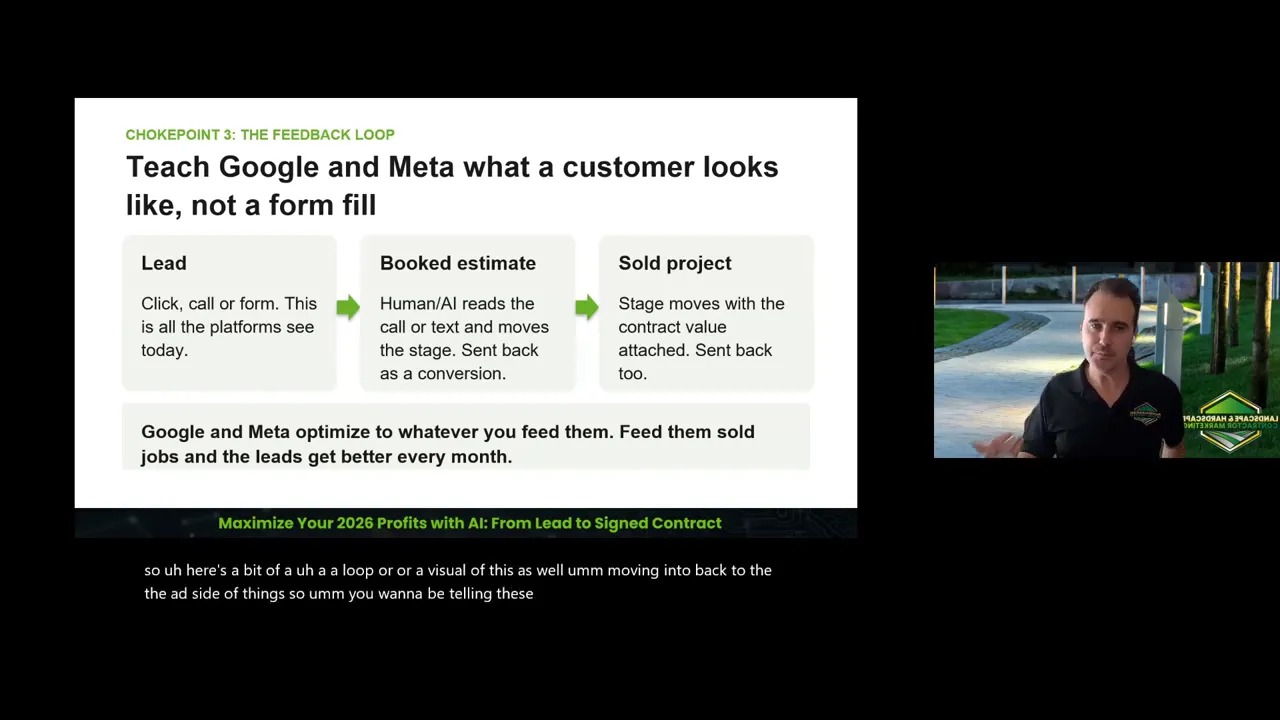
A person can update these stages in the CRM, or connected systems can help move a lead along based on calls, messages, and bookings. The important part is accuracy. When sold jobs and their values are sent back as conversions, the advertising platforms have a stronger signal than a pile of anonymous submissions.
This setup takes technical work, but it is worth understanding even if somebody else manages your campaigns. Ask whether your accounts receive data on qualified leads, booked estimates, and sales. Ask whether the team can connect spending to project value.
Your ad accounts are assets. They learn from the information you feed them over time. Treating every inquiry as a win leaves that asset undertrained. Connecting ads to real outcomes gives your landscape marketing a better chance to improve.
Calculate the Cost of Unanswered Qualified Leads
You do not have to guess whether slow response is worth fixing. Run a simple opportunity calculation using your own numbers:
Qualified inquiries missed or answered late each week × close rate × average job value = estimated weekly revenue opportunity.
For example, take three qualified inquiries per week, a 25% close rate, and an $18,000 average job:
3 × 0.25 × $18,000 = $13,500 per week.
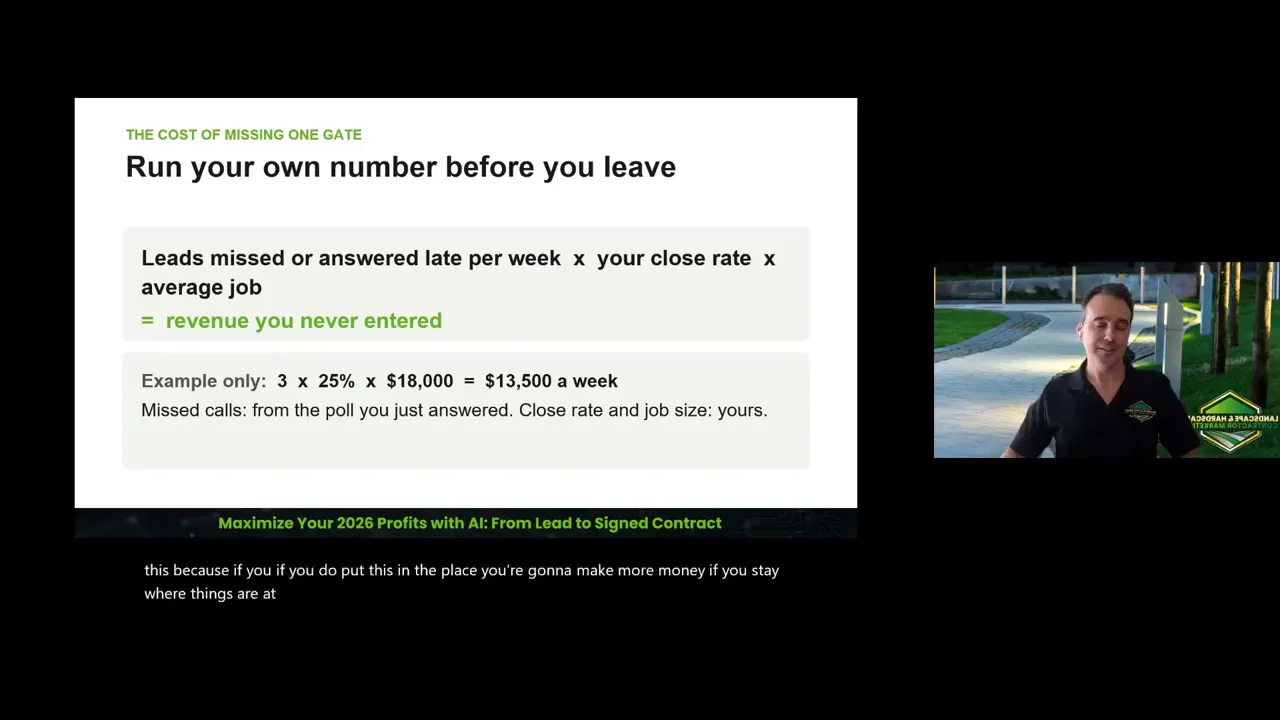
That $13,500 illustrates potential revenue at risk, not a guarantee that all three people would have hired you or that every dollar would have been profit. The point is to put a scale on the opportunity you may be ignoring.
Use qualified inquiries in your calculation, not every spam call or unrelated request. Substitute your actual close rate and average project value. If you don’t know how many inquiries you miss or where they go afterward, that is another reason to put a CRM and a consistent intake process in place.
Landscape marketing gets much easier to prioritize when you can compare the cost of a fix with the value of opportunities currently slipping away.
A 30, 60, and 90-Day Plan for Landscape Marketing and AI
You do not need to implement every idea at once. Start with the gaps that can lose a ready-to-talk customer today, then build the content and technical connections around them.
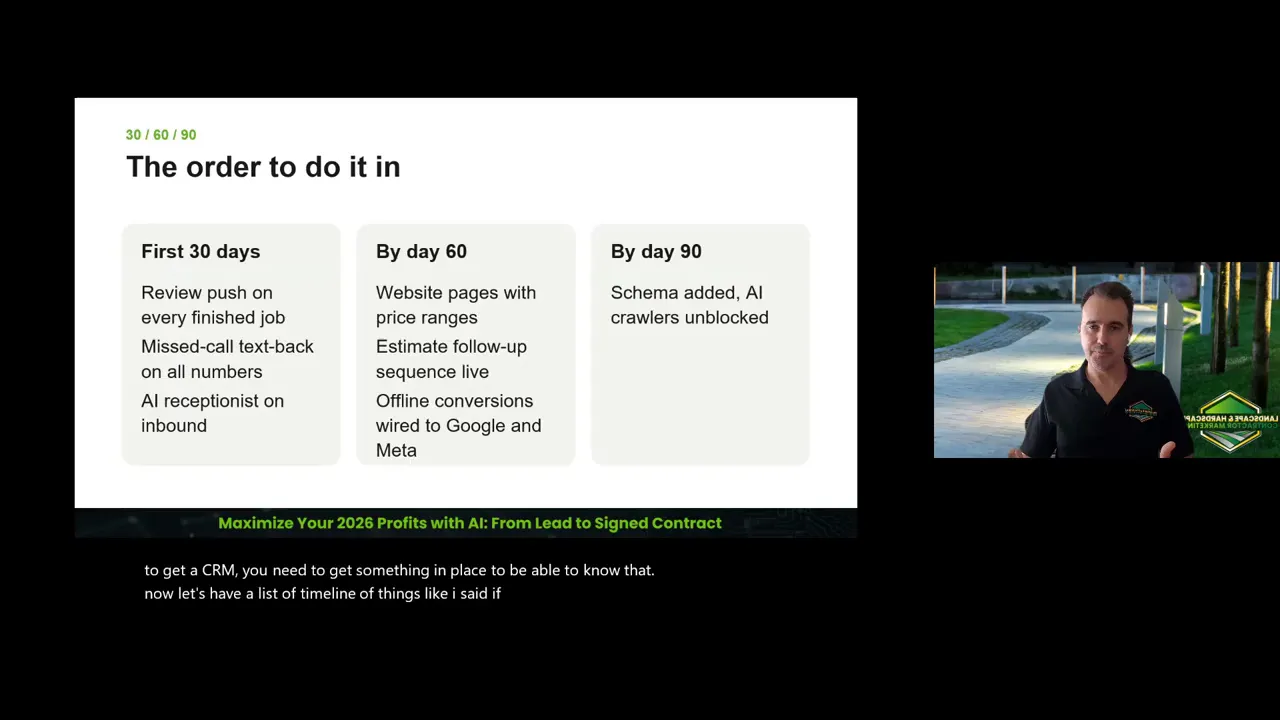
First 30 days: stop losing the inquiry
Get a CRM in place if you cannot reliably see calls, leads, bookings, and outcomes. Set up missed-call text back as a minimum safeguard. Add an AI receptionist as backup, particularly for after-hours calls, and make sure someone on your team owns the callback.
At the same time, start a review push and collect content from completed projects. These actions strengthen discovery while you repair first contact. Test the business number yourself so you know what customers actually experience.
By 60 days: build proof and a repeatable sales process
Turn the photos, testimonials, and project information you collected into useful website pages. Include pricing or starting ranges where you can explain them honestly. Make it easier for a homeowner to understand whether your work fits their project before they reach out.
Build your sales follow-up process inside the CRM. Decide what happens before an estimate, after one is booked, and after one is sent. If you run ads, begin connecting stronger conversion signals so the accounts can distinguish inquiries from booked estimates and sold jobs.
By 90 days: strengthen the technical foundation
Check that AI crawlers can access the site content you have built. Review relevant schema and the other technical elements that help platforms understand your business. Refine your qualification and conversion feedback as your team gathers more real data.
The order matters. A technical adjustment cannot replace project content you never published. A polished ad cannot answer a phone nobody picks up. Each stage of this plan supports the next, moving your landscape marketing from isolated tasks toward a connected process.
Start With the Gap You Can Prove
The most useful audit is an honest one. Call the business number. Look up the last three sold jobs. Check the dates on your recent reviews. Open a project page and ask whether it answers a homeowner’s questions about the work and its likely cost.
Then follow an inquiry through your own system. Who responds in the first minute? Who calls back within five? Who follows up after the estimate? Can you tell which marketing source produced the signed contract?
AI can help a contractor get found, respond when the office is closed, draft useful follow-up, and give ad platforms better information. It cannot make up for a missing process or a business that does not communicate. Build the process first, keep the human relationship at its center, and use the tools to make sure good opportunities get the attention they deserve.
|

Josh Blakeley
Founder of Landscape & Hardscape Contractor Marketing and author of Backyard Empire. A member of the California Landscape Contractors Association (CLCA), Josh has helped contractors book more high-value jobs through done-for-you marketing built only for outdoor living pros.