Your Next Dream Client Is Asking AI, Not Google: AEO for Landscape Contractors
Search has changed fast. Homeowners no longer just type a few keywords into Google, scroll through a map pack, and call several companies. Increasingly, they are asking AI a direct question: “Who is the best landscaper near me?” “What does a paver patio cost here?” “Who can install artificial turf this month?”
That changes the game. The objective is no longer simply to rank somewhere on the page. It is to become a business that an answer engine can confidently recommend.
This is where Answer Engine Optimization, or AEO, comes in. For landscape, hardscape, and outdoor living companies, AEO means making your business easy for AI platforms to understand, trust, and cite. It is not a replacement for SEO. It sits on top of solid local SEO and raises the standard for how clearly your business presents itself across your website, profiles, reviews, directories, and video.
AEO Is Built on SEO, Not Hype
There is plenty of noise around AI search. Do not chase every shiny tactic. The fundamentals still matter because AI answers are largely built from the same ecosystem that supports local search: websites, business profiles, reviews, directories, videos, local authority, and clear evidence that you are a real, reputable company.
If your business is not visible in Google search today, it is unlikely to be consistently surfaced in AI results. Great SEO remains the foundation. AEO adds a layer of specificity by ensuring AI can quickly find direct answers about your services, service area, expertise, process, pricing ranges, reputation, and availability.
The good news is that the sources are often visible. When an AI platform recommends a company, it may cite that company’s website, Google Business Profile, Yelp listing, local directory, review platform, Reddit discussion, or a local publication. Those citations give you a practical reverse-engineering opportunity. See who is being recommended in your market, identify the sources supporting that recommendation, and close the gaps in your own presence.
How AI Engines Find and Recommend Contractors
Different AI platforms pull from different places. ChatGPT commonly draws local information from Bing Places, map listings, websites, review platforms, and online discussions. Google AI Overviews and Gemini can draw heavily from Google’s own local ecosystem, website content, Google reviews, and YouTube.
That means no single magic profile wins everywhere. An AI answer may identify one contractor because the company clearly displays awards and credentials on its website. Another may be selected because reviews repeatedly mention attentive work, detailed communication, or a particular service. A third may be included because a trusted local directory or community discussion references the business.
Think of AEO as building a consistent body of proof across the internet. Your business should be easy to describe in a sentence:
What exactly do you do?
Where do you do it?
Who do you serve?
What services or specialties make you different?
Why should a homeowner trust you?
What does the process look like?
Licensing, insurance, years in business, awards, professional memberships, service specialties, project results, and genuine customer feedback all help answer those questions. Put that information on your website, Google Business Profile, and relevant social and directory profiles. If it exists only in your head or on a truck wrap, AI has nothing useful to reference.
Start With Your Google Business Profile
Your Google Business Profile is no longer a set-and-forget listing. It is live infrastructure for local visibility. Google may now show only one or two recommended businesses in certain AI-powered results where a fuller map pack once appeared. Getting considered is one thing. Being selected is another.
Make the profile as complete and current as possible. The essentials include:
The right primary category. A design-build company may fit “landscape designer,” while a full-service operation may need “landscaper” as a key category. Add relevant secondary categories for actual services.
Accurate location and service information. Ensure the address, service area, phone number, website, and business hours are correct and consistent.
A complete business description. Use the available character space to explain your expertise, services, locations, differentiators, and experience.
Detailed services. Add every meaningful service, with descriptions and price ranges where appropriate.
Fresh proof. Publish Google Business Profile posts, project photos, and short videos regularly.
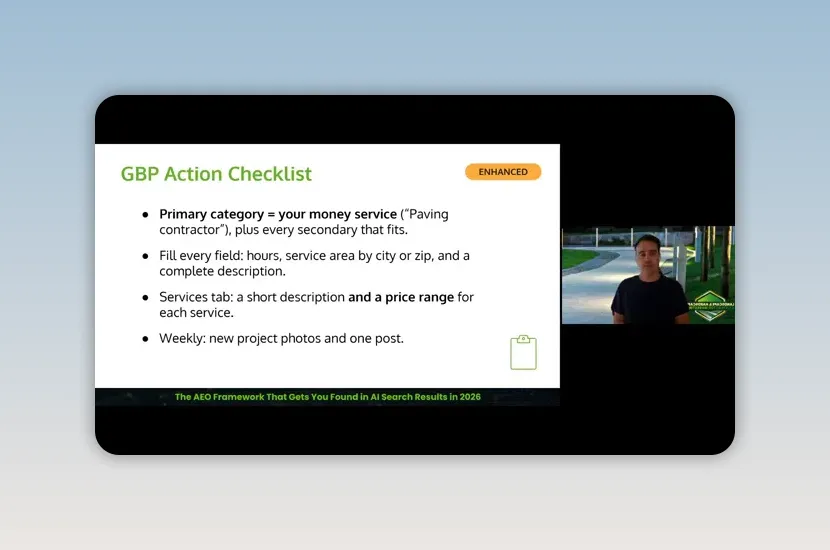
A complete, regularly updated profile gives Google and AI systems clearer signals about your business.
Your website link inside the profile deserves attention too. If you serve multiple markets, point each location profile to the most relevant location page. The landing page should clearly match the business, area, and services being presented. A generic homepage can work for one core market, but a well-built location page is often stronger for a specific location.
Also, sync your profile to Bing Places. Since Bing data can feed AI search experiences, it is an easy way to extend a well-managed local listing into another important ecosystem.
Fresh, Detailed Reviews Are a Major AEO Asset
Reviews are no longer simply social proof. AI platforms can read review content and use it to understand what a company is known for. Review recency matters too. A steady flow of new reviews is more valuable than a large pile of old ones with nothing recent behind it.
Google should be the main priority, but do not stop there. Where it makes sense for your business, build a real presence on Yelp, Facebook, Houzz, BBB, and other relevant platforms. AI systems do not all cite the same sources, and third-party platforms can become the proof that gets your business mentioned.
The strongest reviews are specific. A short “Great work” is appreciated, but it does not give an answer engine much useful detail. A review that mentions the project type, location, team communication, workmanship, planning, drainage work, design process, timeline, or finished result tells a far richer story.
Build review collection into the closeout process for every project. Take final photos and videos, ask for the review personally, and support the request with an automated follow-up. For a larger project, consider briefly interviewing the client about their experience. Summarize the project accurately, send it for approval, and let the customer change anything before posting. That can produce a detailed, authentic review with long-term AEO value.
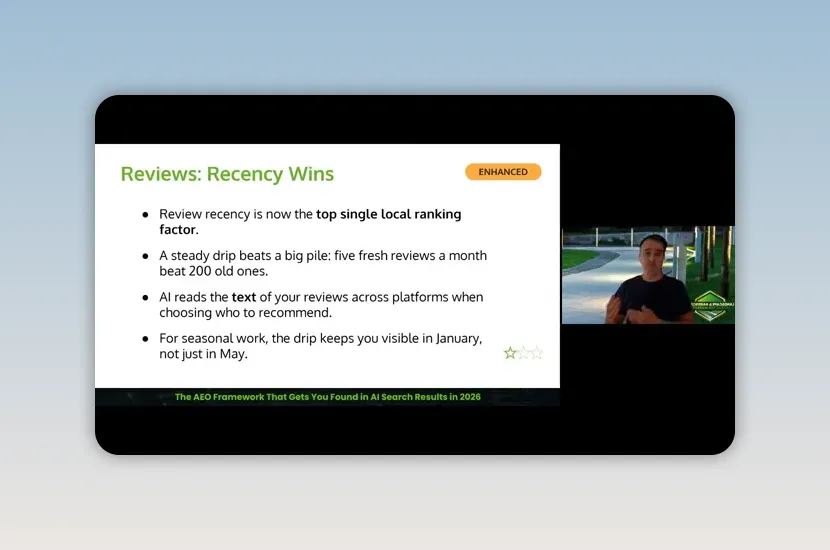
The goal is not just more reviews. It is a reliable flow of recent, specific feedback about real projects.
Build Service Pages That Answer the Entire Question
Thin pages lose because AI does not stop at the first question. When someone asks, “What does a paver patio cost in this area?” an answer engine may also look for related information about base preparation, drainage, permits, materials, access, project timing, and the factors that affect the final investment.
That is why a generic services page isn’t enough. Every core service deserves its own substantial page. If you install patios, retaining walls, outdoor kitchens, artificial turf, landscape lighting, drainage, or pools, create a clear page for each.
A strong service page should answer:
What the service is and who it is for
How your process works
Common design and material options
Typical cost factors or price ranges
Permitting, drainage, preparation, and timeline considerations
Frequently asked questions
Relevant completed projects
The core region you serve
Put the direct answer near the top of the page. Don’t bury useful information beneath a long introduction. FAQs are especially helpful because they mirror the practical questions homeowners ask.
Pricing content is worth addressing directly. You do not have to publish every exact number. You can provide ranges, explain the variables that affect cost, and show how the project scope changes the investment. Clear pricing guidance attracts better-fit leads and gives AI useful material to work with.
Project pages are equally important. Document real work with before-and-after photos, project scope, an approximate budget range (if you are comfortable sharing it), timeline, neighborhood or general location, materials, challenges, and results. These pages become evidence that you do the work you claim to do.
Use City Pages Properly
Location pages should be genuinely useful, not copies of the same page with a city name swapped out. Google has tightened up on that kind of spam. Build pages for meaningful cities, neighborhoods, or service areas and include relevant local context, actual projects, and information specific to the area.
Keep your structure clean. Service pages should focus on the service across your primary region. Location pages should focus on the location and the work you do there. Avoid creating endless service-plus-city combinations that only make the site harder to scan and maintain.
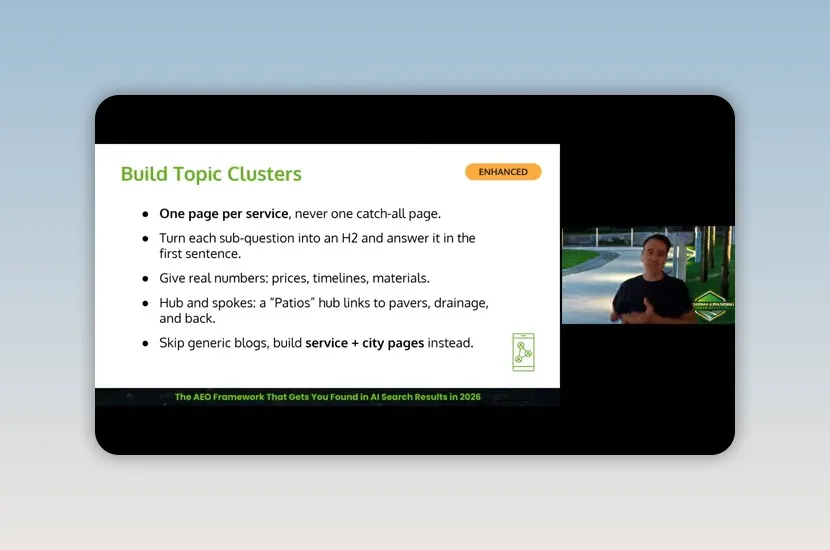
One focused service page should cover the related questions that sit behind a homeowner’s initial search.
Make Your Brand Easy to Understand and Trust
Clarity wins. The more specific homeowners become in their searches, the more specific your online brand must be. If you specialize in artificial turf, high-end outdoor living, drainage solutions, natural stone, or design-build work, say it clearly. Explain who you serve, what projects you take on, and what makes your approach different.
A simple way to uncover this material is to have someone interview the owner or key team members. Ask about the process, standards, materials, client experience, problem-solving, and why the company operates differently from competitors. Those answers are gold for an About page, a “How We Work” page, service pages, sales materials, and video topics.
Then reinforce credibility across the web. Keep your name, address, and phone number consistent on your website, social channels, directories, local memberships, and professional profiles. Join the local chamber, sponsor a community event or charity, and pursue legitimate local backlinks. Local authority helps SEO and gives AI more trusted references to connect back to your company.
For outdoor living contractors, profiles on Houzz, BBB, Angie, HomeAdvisor, Nextdoor, and relevant local directories are all worth considering. You can also create a free Outdoor Spaces HQ business profile to add another relevant industry citation.
Schema and Technical SEO Still Matter
Schema markup is structured data in the backend of your site. It helps search engines understand the information on a page instead of inferring everything from visible copy. It is not glamorous, but it is one of the underused edges in AEO.
At a minimum, make sure your site can support appropriate local business and service schema. Project pages, FAQs, breadcrumbs, and specialized business information may also be valuable depending on the site structure. Schema.org provides the shared vocabulary used for this type of structured data.
The bigger point is to use a website platform and technical setup that can properly support SEO. Fast-loading pages, logical headings, title tags, schema, clean navigation, and crawlable content are foundational. A site that looks fine but cannot properly support technical SEO will struggle to compete in both traditional and AI search.
Use Short-Form Video to Create More Evidence
Short-form video is another opportunity to show up in Google results and give AI clearer context about your work. Capture video throughout the job: site walkthroughs, design explanations, construction stages, material choices, drainage solutions, final reveals, and quick answers to common questions.
Publish that content across the appropriate channels, including YouTube, Instagram, Facebook, TikTok, and your Google Business Profile. Then embed the best matching videos on the relevant service or project pages.
With YouTube, be specific in the title and description. A video about patio pricing should identify the project type and local market. A project video should mention the neighborhood or relevant area, the scope, and the important work completed. This makes it easier for search systems to connect the video, webpage, service, and location.
Be Ready When Google Calls
Google’s AI is beginning to call businesses in some industries to check information such as availability and pricing. This is not yet widespread in design-build landscaping and outdoor living, but it is a clear signal of where local search is heading.
Do not let calls drift to voicemail during business hours. Make sure a real person, or a capable after-hours AI assistant, can respond. The team should know the current availability, service area, basic pricing ranges, and how to handle a request quickly. If an AI agent cannot get a useful answer, it cannot confidently move the lead forward.
How to Measure Whether AI Recommends You
There is no universal notification when an answer engine recommends your business. That means you need a simple recurring process.
Open an incognito browser so your personal search history doesn’t distort the results.
Ask Google, ChatGPT, Gemini, and other relevant platforms the questions real prospects ask.
Search by service, city, specialty, budget concern, and project type.
Record which companies appear and which sources the platforms cite.
Compare those sources to your own online presence.
Repeat the process each month to spot changes and opportunities.
Ask your sales team to track lead sources as well. Add a simple question to every inquiry: “How did you find us?” If someone says ChatGPT, Gemini, an AI overview, YouTube, or a directory, record it in your CRM. AI-driven leads are still a growing share of overall lead flow, but the businesses building the foundation now will be better positioned as the channel grows.
Your AEO Starter Plan for This Week
Do not try to rebuild your entire marketing system overnight. Start with the highest-leverage work and stack wins from there.
Audit and complete your Google Business Profile. Fix categories, hours, services, description, photos, posts, and landing page links.
Start a consistent review process. Make the ask part of every project closeout and focus on recent, detailed feedback.
Choose one key service cluster. Build or improve one real service page with pricing context, process details, FAQs, and project evidence.
Claim the essential directory profiles. Start with Bing Places, Yelp, BBB, Houzz, and the platforms that matter in your market.
Publish one useful project or FAQ video. Title it clearly, include location and service context, then embed it on the matching page.
Run monthly AI recommendation checks. Use the citations to guide the next improvement.
If you only do two things first, make them your Google Business Profile and a steady flow of fresh reviews. Those have been local SEO priorities for a long time, and they remain central as AI search becomes part of how homeowners choose contractors.

Josh Blakeley
Founder of Landscape & Hardscape Contractor Marketing and author of Backyard Empire. A member of the California Landscape Contractors Association (CLCA), Josh has helped contractors book more high-value jobs through done-for-you marketing built only for outdoor living pros.