Off-Season Landscape Marketing: Book Spring 2027 Before Your Competitors Wake Up
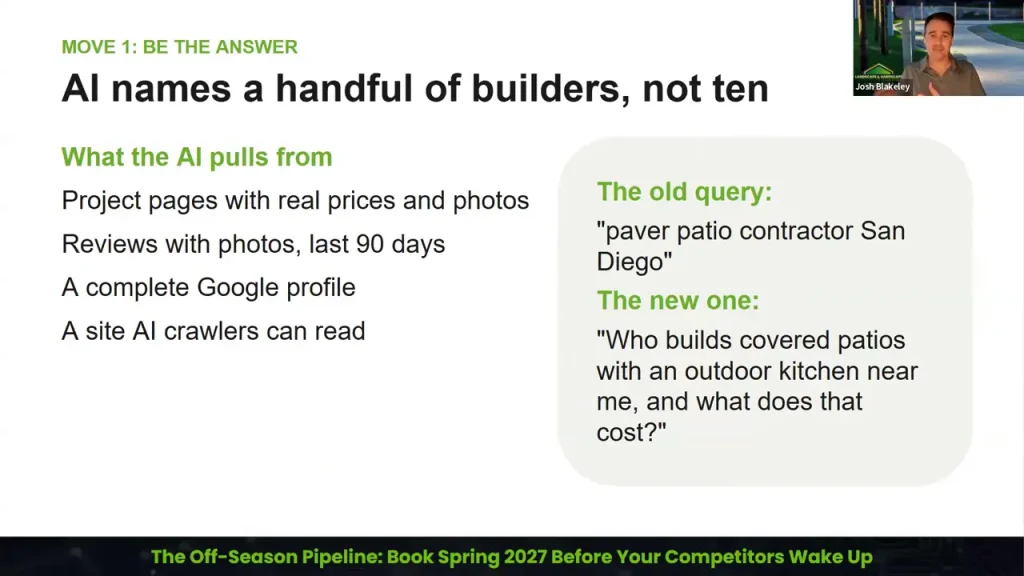
Table of Contents
Introduction: The Off-Season Pipeline
Call your own business number after 6 p.m. on a Sunday. What happens? Does somebody answer? Does a missed call trigger a text back? Or does a homeowner planning next spring’s backyard get voicemail and nothing else?
That simple test tells you quite a bit about your landscape marketing. You can put money into getting found, build a great website, and show beautiful projects. But if the next step falls apart, you are making it harder to turn that interest into work.
Winter is the time to connect those pieces. For landscape, hardscape, and outdoor living contractors, especially design-build businesses, the off-season is not just a gap between installation seasons. It is an opportunity to get into conversations, develop designs, and build a spring schedule before everyone else starts chasing the same homeowners.
The landscape marketing strategy comes down to three moves:
Be the answer: Give Google and AI search platforms useful reasons to name your business.
Sell the design: Offer a clear planning step homeowners can commit to before the new year.
Book it warm: Respond quickly and follow up so an inquiry becomes a scheduled conversation.
None of these works particularly well in isolation. Visibility needs an offer. An offer needs follow-up. And follow-up needs a system that keeps working when your team takes a break.
Why the Winter Sets Up 2027
Homeowners don’t stop thinking about their outdoor spaces just because your installation schedule slows down. During the holidays, they may have more time to research. They are entertaining family, noticing what does not work in the backyard, and discussing what they would like to change.
That is why winter landscape marketing matters. Someone might not be ready for construction in December, but they can still be ready to explore a design, understand a budget, or choose a contractor.
Two indicators help explain the opportunity. BrightLocal figures cited for 2025 and 2026 show the share of people using AI tools to find local businesses increasing from 6% to 45%. Separately, the Google Trends comparison for landscape design showed winter search interest holding at about 60% of spring interest.
That second number is search interest, not a promise that winter produces 60% of spring’s leads. The useful takeaway is simpler: meaningful research activity continues through the winter.
Meanwhile, some contractors pull back or disappear from advertising altogether. Your landscape marketing can stay present while homeowners decide what to do.
Think of November through January as a planning window. Use it to improve your project content, clarify your consultation offer, and fix the response process. The goal is not to force every homeowner into an immediate construction decision. It is to give interested people a practical next step now, rather than asking them to remember you in March.
A spring pipeline starts with winter conversations. Waiting for the weather to change means waiting until other contractors are having those conversations too.
Getting Named by ChatGPT and Google AI
Search used to be easier to picture: a page of Google results, with ten listings competing for attention. Google now presents a much more varied results page, and AI answers can narrow the choice further by recommending only a handful of companies.
For landscape marketing, that makes the information behind your business especially important. A platform needs something useful to draw from when somebody asks who builds covered patios, installs outdoor kitchens, or handles a complete backyard project.
Make real projects the foundation
Your website should explain more than the services you offer. Build pages around substantial projects you have actually completed, with details such as:
The neighborhood or area where the project took place.
What the homeowner wanted to achieve.
The design approach and the work included.
Materials, products, and manufacturers used.
Photos and, where available, project video.
A realistic price range for the work shown.
These details help explain what your company is best suited for. They also make your landscape marketing more useful to homeowners comparing options, not just collecting company names.
In sample searches for covered patios and outdoor kitchens, Google AI Mode and ChatGPT returned small groups of businesses with descriptions of their specialties. Those descriptions included things like high-end outdoor kitchens, solid-roof patios, and suitability for a single-contractor project. Specific information gives search systems more to work with than a generic claim that you do quality work.
Keep the fundamentals working
Recent reviews still matter. Aim for a steady review process, including feedback from the last 90 days, rather than relying only on older reviews. Keep your Google Business Profile complete and optimized, and check that your website is accessible to the relevant AI crawlers.
AI search is not a reason to abandon solid SEO. It is another reason to make your landscape marketing specific, current, and technically accessible.
Would ChatGPT Name You Tonight?
Before making assumptions about AI visibility, check it yourself. Open ChatGPT and ask for your main service in your town. You can start with the free version. Then try the same kind of question in Google AI Mode.
Use the language a homeowner would use. Search is becoming more conversational, particularly when people can speak a detailed question into their phones. They are not always entering only a service and a city anymore.
A homeowner might ask who can build a covered patio with an outdoor kitchen nearby and what that kind of project costs. That question combines service, location, scope, and budget. Your landscape marketing content should help answer those concerns.
Look at what comes back. Is your business named? Which businesses are recommended? What does the answer say they specialize in? Where does the supporting information come from?
Treat this as a practical check, not a guarantee of what every future search will return. It gives you a starting point for improving your landscape marketing.
Over the next 30 days, focus on a manageable set of actions:
Record your starting point. Save the results for your main service and location.
Publish your strongest projects. Create individual pages with photos, project details, and price ranges.
Gather supporting content. Collect project video and request recent customer reviews.
Check website access. Ask your hosting support team whether relevant AI crawlers are being blocked.
You do not need to guess at the technical side. Hosting setups differ, so ask the team responsible for yours to investigate. Strong project content cannot do its job if the systems you want to reach cannot read it.
Selling the Design Consult Before the New Year
The winter offer should not amount to asking homeowners to call back in spring. Give them something they can say yes to while they are already thinking about the project.
For design-build contractors, that is often a design consultation or a design planning step. It may be free, or you may charge a fee that is credited against the build. The right structure depends on how your business already sells and delivers design.
The important landscape marketing move is to make that structure clear. Explain what the homeowner can book now, how the fee works if there is one, and how planning relates to your spring availability.
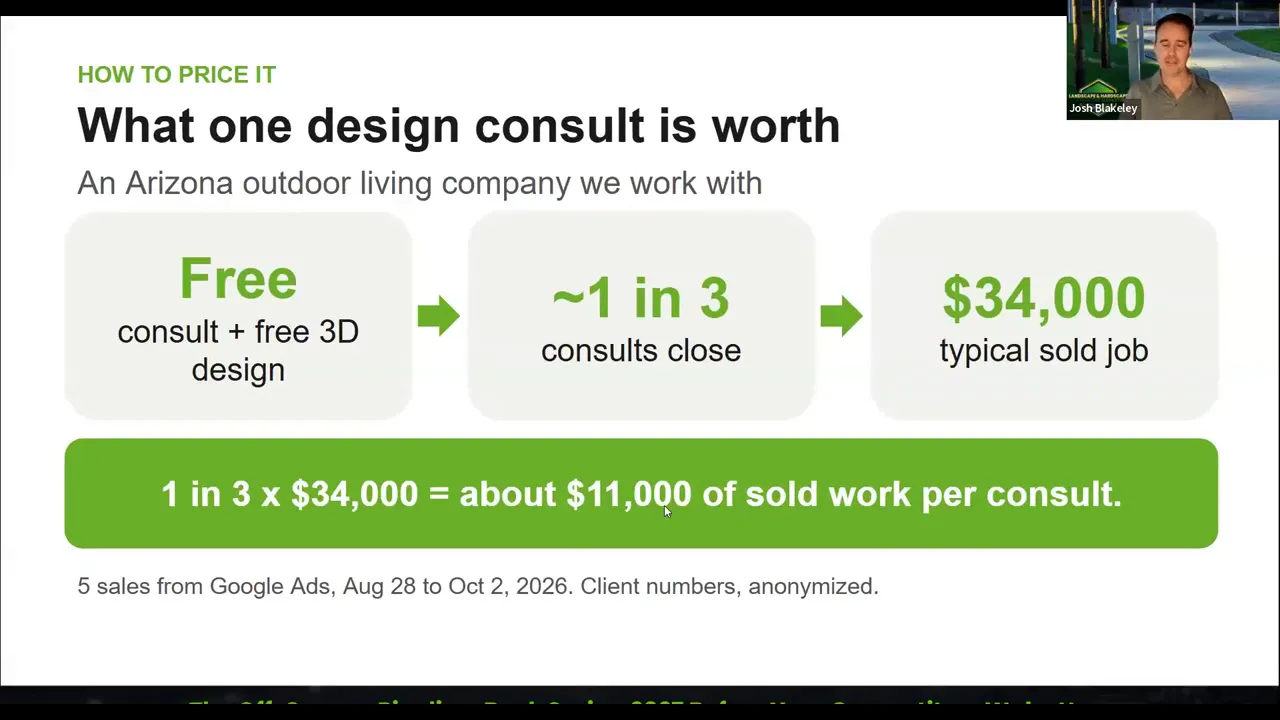
We have seen the value of this with an outdoor living client offering a free consultation and free 3D design. In the results discussed, roughly one in three consultations closed. Using a conservative sold-job value of $34,000, that works out to about $11,000 in sold work per consultation across the group.
That does not mean every consultation produces an $11,000 sale. It is an average based on the close rate and project value. The example drew on five Google Ads sales from late August into early October, so it is a client example, not a universal benchmark.
Still, it shows why consultations deserve attention in your landscape marketing. The same reasoning applies whether inquiries originate from Google Ads, SEO, AI search, Meta, or printed materials.
Write your offer in one sentence. Decide whether it is free or credited, and define the credit rule. If you genuinely reserve spring installation capacity for winter clients, explain that too. Clear availability creates a reason to act without a pushy sales pitch.
Price Ranges and Instant Estimators
A homeowner researching a backyard project usually wants some idea of cost before getting deeply involved. Making that information available can be a useful part of winter landscape marketing.
There are two related opportunities here. First, include real price ranges on project pages. Second, consider an instant estimator that asks a few questions and provides a preliminary range.
A price range is not a quote. Keep that distinction clear. The purpose is to help someone understand the likely scale of investment, not promise a final construction price before you understand the project.
PriceGuide AI is one estimator we have found useful, although other tools exist. At the time discussed, the option shown was around $20 a month. The point isn’t the specific software. It is making an initial budget conversation easier to start.
A basic estimator process looks like this:
The homeowner selects the type of project they are considering.
They answer a few questions.
They provide their details to receive an instant range.
Your follow-up system helps them book a conversation.
Put the estimator button on your homepage or your top service page, where interested people can find it. Do not add it as a disconnected feature. Its value to landscape marketing comes partly from what happens after the form is submitted.
AI agents may also increasingly interact with tools like these on a searcher’s behalf. Treat that as a direction to prepare for, not a guaranteed source of leads today.
The immediate benefit is already practical: the homeowner gets useful guidance, you get context about their project, and both sides have a good reason to keep the conversation going.
What Happens to a December Inquiry
Picture an inquiry arriving on December 23. Your team might be wrapping up for Christmas, or you may already be taking a break. What happens next?
Does someone call that day? Does your customer relationship management system, or CRM, acknowledge the inquiry? Can the homeowner schedule a conversation? Or does the message sit until after the holidays?
This is where a landscape marketing plan must connect with how your business actually operates. Holiday coverage cannot depend on an assumption that somebody will notice the notification.
At a minimum, the homeowner should know the inquiry arrived and what to do next. Ideally, a person responds. When that is not possible immediately, automation can keep the process moving.
A useful response should accomplish three things:
Acknowledge the request. Make it clear you received the submission.
Set an honest expectation. Explain when someone will be available.
Offer the next step. Provide a way to book a short call.
You do not have to pretend the office is fully staffed over Christmas. You do need to avoid leaving an interested homeowner with no direction.
Remember the context. This person may have just been discussing a backyard remodel with family or thinking about entertaining next year. Your landscape marketing got them to reach out. A basic response system helps preserve that momentum while your team is away.
Book It Warm: Speed to Lead
Response speed deserves its own attention because an inquiry and a conversation are not the same.
The older study, The Short Life of Online Sales Leads, reported that businesses that attempted contact within an hour were nearly seven times more likely to qualify a lead than those that attempted contact even an hour later. That research dates back to 2011. It supports the importance of speed, but it is not a current, landscape-specific performance guarantee.
My recommendation for landscape marketing operations is faster:
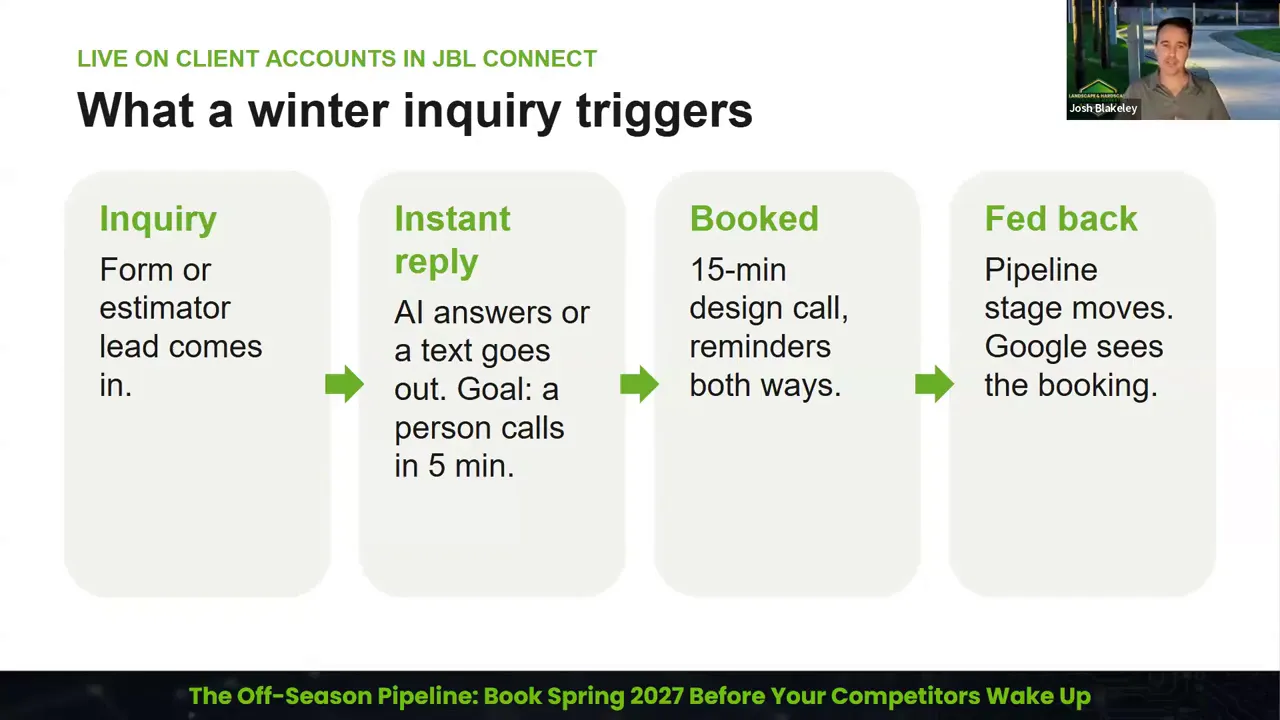
Within a minute: Send an acknowledgment, ideally by text.
Within five minutes: Have someone attempt a call when your team is available.
Immediately available: Let the homeowner book a 15-minute conversation.
A CRM can support this. Some systems can trigger a call that connects an incoming lead with a salesperson. Others can show a booking calendar immediately after a form submission and send reminders before the appointment.
That self-booking option is particularly helpful outside working hours. Somebody researching on Sunday can choose a Monday conversation rather than wait for your team to start a round of phone tag.
Trust is a factor here too. A clear, professional follow-up process gives the homeowner an early indication of how your company communicates. It doesn’t prove how a job will go, but it helps build confidence.
Good landscape marketing should make the next step feel organized. A quick acknowledgment, an easy booking process, and a real conversation are a strong start.
The Follow-Up Workflow, Step by Step
You do not need an unnecessarily complicated system. You need a reliable path from inquiry to booked conversation, with a clear handoff to the person responsible for sales.
Here is the landscape marketing workflow I would build around a website form or estimator.
1. Capture the inquiry
The form submission or estimator request enters your CRM. Keep the project information available so the salesperson has context when following up.
2. Send an immediate response
Acknowledge the request and explain what happens next. Include the booking link so the homeowner can take action without waiting.
3. Attempt personal contact
Have someone call promptly during available hours. Automation supports this step; it should not leave responsibility for the actual conversation unclear.
4. Follow up when no appointment is booked
If the call reaches voicemail or the homeowner has not scheduled, send reminders that make booking easy. Connect those reminders to your real calendar, rather than asking people to suggest times back and forth.
5. Confirm the appointment and send reminders
Once a conversation is booked, make sure both sides know when it is happening. Reminders help carry the inquiry through to the scheduled call.
6. Feed the outcome back to advertising
If the inquiry came through paid advertising, send the booked-consult outcome back to Google Ads or Meta Ads where your setup supports it. That gives the platforms a more meaningful signal than a form submission alone.
This final connection is easy to overlook in landscape marketing. You want advertising informed by the inquiries that progress into useful sales conversations, not just by the number of people who complete a form.
Nurture Emails and Winter Ads
Not every winter inquiry is ready to book immediately. That does not mean the opportunity has disappeared. Some homeowners need more time to think through the design or decide when to proceed.
A landscape marketing follow-up plan should include those people without treating every message like a closing attempt.
Stay useful in the inbox
Project updates and a monthly email can keep your business top of mind. Share completed work, design ideas, and project information that helps homeowners understand what is possible.
A simple seasonal sequence might look like this:
November: Send design inspiration and a project photo, then continue monthly.
January: Explain spring availability and encourage planning if slots really are filling.
March: Make a personal follow-up call or send a final availability message.
Only use scarcity when it is true. Real scheduling information is useful. Manufactured urgency is not necessary.
You can also revisit inquiries from a few months earlier when you want to bring in additional work. A personal call gives you a chance to find out whether the project is still moving forward.
Keep some advertising active
Even in snow states where installation slows significantly, consider maintaining a smaller winter advertising presence. Meta ads can feature finished projects or the founder explaining the business. Google Ads can continue reaching the people who are still searching.
Search traffic may decline, but some competitors stop advertising too. That is a reason to evaluate the opportunity, not a promise that winter leads will always cost less.
The landscape marketing principle is to stay present at a sensible level, then connect booked consultations and sales outcomes back to the advertising systems.
The After-Hours Checklist
Do not assume your system works because someone configured it months ago. Test it as a homeowner would.
Call your business after 6 p.m. on a Sunday. Submit a website form. Try the estimator. Follow the booking link. Look at what actually arrives on your phone and in your inbox.
This landscape marketing check should answer the following:
Does a missed call trigger a text back?
Does every form or estimator submission receive an acknowledgment?
Is the response quick enough to keep the conversation moving?
Does the booking link open a calendar with genuine availability?
Can someone schedule a 15-minute conversation without contacting the office again?
Do appointment reminders reach the right people?
Do you have a nurture plan for homeowners who aren’t ready?
Does someone on your team know who owns follow-up?
Check all the business numbers homeowners might use, not just the one you happen to call most often. The response experience should not depend on which entry point they choose.
Also have someone sign up for your business email list and review what they receive. A nurture schedule only helps if the messages are actually going out.
These are small operational checks, but they protect the effort going into landscape marketing. Finding a broken booking link or a missing acknowledgment now is better than discovering it after a holiday’s worth of inquiries has gone quiet.
Run Your Winter Numbers
Once the process is clear, put some numbers around the opportunity. You don’t need a complicated forecast to see why winter consultations matter.
Start with this calculation:
Winter consultations × close rate × average sold-job value = potential booked project revenue.
Using the example discussed:
Winter consultations: 12.
Close rate: 40%.
Average project value: $25,000.
Modeled project revenue: $120,000.
The arithmetic is 12 × 0.40 × $25,000. The resulting 4.8 jobs is a forecasting average, not a suggestion that you will sell a fraction of a project.
This is potential revenue, not profit or guaranteed cash collected before spring. Actual sales, project timing, and delivery still have to happen.
Use your own historical close rate and average job size. If those figures differ from the example, your forecast should differ too. The purpose is to understand what a realistic winter pipeline could mean for your business.
This also gives landscape marketing a more useful target than simply generating more leads. How many consultations do you need? How many become sold projects? What is the value of those projects?
Then work backward to the practical improvements: better project content, a clearer design offer, quicker responses, or more consistent follow-up. Your numbers help show why those improvements deserve attention before the spring rush.
Recap: Be the Answer, Sell the Design, Book It Warm
The strongest winter landscape marketing plan is not a collection of disconnected tactics. It is a working system that helps homeowners find you, understand the opportunity, and take the next step.
Put the work in a practical order:
November: Check AI visibility, publish detailed project pages, request recent reviews, and write your design consultation offer.
December and January: Book consultations, explain genuine spring availability, and keep immediate responses and nurture messages running through the holidays.
February and March: Make sure the estimator and booking process are working, follow up with earlier inquiries, and adjust advertising as the season approaches.
Keep the three priorities in front of your team. Be the answer by publishing evidence of the work you do. Sell the design by offering a planning step people can commit to now. Book it warm by responding quickly and making scheduling easy.
For a broader look at the digital side of growing an outdoor living business, you can get a free copy of Backyard Empire. If you want help connecting your landscape marketing, lead handling, and automation, book a discovery call.
Start with that Sunday phone test. Then fix the gaps it reveals. The spring calendar can begin filling in winter, while other contractors are still waiting for the season to start.

Josh Blakeley
Founder of Landscape & Hardscape Contractor Marketing and author of Backyard Empire. A member of the California Landscape Contractors Association (CLCA), Josh has helped contractors book more high-value jobs through done-for-you marketing built only for outdoor living pros.